



An emergency fund is one of the most important things you can build for your financial peace of mind.
It’s not about being rich. It’s about having a safety net so that a broken car, a medical bill, or a sudden job change doesn’t throw your entire life into chaos. Yet most people never build one — or they build one that’s too small and then watch it disappear the first time life happens.
This guide is for anyone starting from zero or with very little saved. It’s practical, realistic, and written for normal people with normal incomes. No complicated math. No extreme sacrifices. Just clear steps that actually work.
Step 1: Decide What “Enough” Looks Like for You
The classic advice is 3–6 months of living expenses. That’s a great long-term goal, but it can feel overwhelming when you’re starting from zero.
Start with a smaller, motivating target first:
- Mini emergency fund: $1,000 This covers most small surprises (car repair, dentist bill, appliance breakdown).
- Next level: 3 months of essential expenses This gives real breathing room.
- Full goal: 6 months (or more if your job is unstable or you have a big family).
Write down your current monthly essentials (rent, food, utilities, transport, minimum debt payments). Multiply by 3 or 6. That’s your target. Seeing the actual number makes it feel achievable instead of impossible.
Step 2: Open the Right Account
Your emergency fund should be safe, easy to access in a real emergency, but not too easy (so you don’t dip into it for vacations or new shoes).
Best options:
- High-yield savings account at an online bank
- Separate savings account at your current bank (just label it clearly as “Emergency Only”)
Do not keep it in your checking account. Do not keep it in a brokerage account where it can lose value. It needs to be safe and liquid.
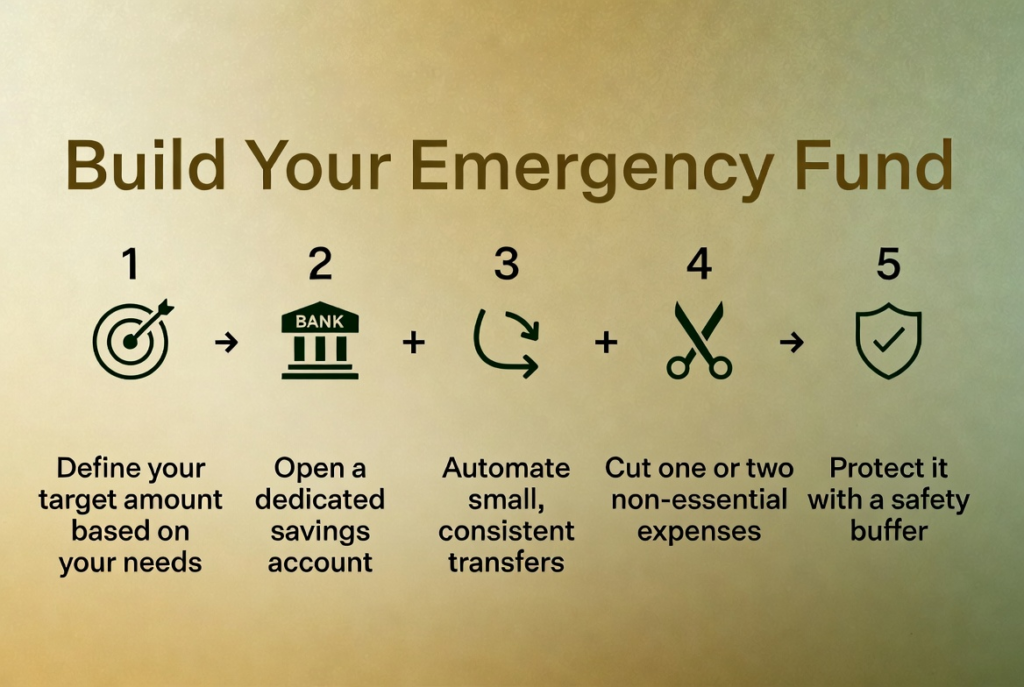
Step 3: Automate Tiny but Consistent Contributions
The secret to building any savings goal is automation.
Set up an automatic transfer from your checking account to your emergency fund the same day (or the day after) you get paid. Even if you start with only $25 or $50 per paycheck, that’s fine.
Why automation works:
- You never have to “remember” or feel the pain of manually moving money
- You adjust your spending to what’s left
- Small amounts add up faster than you expect
Increase the amount by $10–$25 every few months as your income grows or expenses drop.
Step 4: Free Up Money Without Feeling Deprived
Look at your last 30 days of spending and find one or two areas where you can redirect money without hating your life:
- Cancel subscriptions you don’t use
- Cook one extra meal at home each week
- Negotiate one monthly bill (insurance, phone, cable)
- Sell items you already own
The goal is not to live like a monk. It’s to redirect even $100–$200 a month toward your emergency fund.
Step 5: Protect the Fund Once It’s Built
This is the part most people miss.
Rules for your emergency fund:
- It is only for true emergencies (job loss, major medical, car repair that keeps you working).
- It is not for vacations, gifts, or “I really want this.”
- When you use part of it, immediately start rebuilding it.
Treat it like insurance — you hope you never need it, but you’re incredibly grateful when you do.
Real-Life Proof It Works
- Laura started with $0 and $42k income. She automated $75 per paycheck. In 11 months she had $2,000 saved and handled a $1,400 car repair without stress.
- A young couple with two kids built their 3-month fund in 14 months by combining small automatic transfers with selling unused baby items online.
They didn’t get raises. They didn’t cut everything fun. They just stayed consistent.
Your 30-Day Starter Plan
Week 1: Calculate your target and open the dedicated savings account. Week 2: Set up your first automatic transfer (even $25–$50). Week 3: Track spending and cut or redirect one small expense. Week 4: Review your progress and celebrate — even a few hundred dollars is a win.
The Bottom Line
A bulletproof emergency fund isn’t about having a perfect life. It’s about having a financial cushion so life’s normal bumps don’t knock you down.
You don’t need a high income. You don’t need to be perfect. You just need to start small, stay consistent, and protect what you build.
Financial peace is closer than you think — and it begins with one small, automatic transfer today.
Have you started building an emergency fund yet? What’s been your biggest challenge, or what’s one small step you’re ready to take this month?
Share in the comments — your experience can help someone else who feels exactly where you are right now.
For more practical money guides, check our articles on stopping the paycheck-to-paycheck cycle, paying off debt without feeling deprived, creating budgets that actually work, and investing in the stock market and ETFs right here on Next Future Finance.
Your emergency fund — and your peace of mind — starts with one decision today.











Deja una respuesta