



Cryptocurrency can feel exciting, scary, and confusing all at the same time.
One day Bitcoin is at $60,000, the next it’s dropping 15%. You hear stories of people becoming millionaires… and others losing everything. So how do normal people invest in crypto without losing sleep — or their money?
This guide is written for beginners who want to get started the smart way. No hype. No “get rich quick.” Just clear, honest, and practical steps for 2026.
Step 1: Understand What You’re Getting Into
Crypto is not like buying stocks. It’s volatile, 24/7, and still relatively new. Treat it as a high-risk part of your portfolio — never money you can’t afford to lose.
Golden rule: Only invest what you would be okay losing 50–100% of in the worst case.
Start small. Learn as you go. This is a marathon, not a sprint.
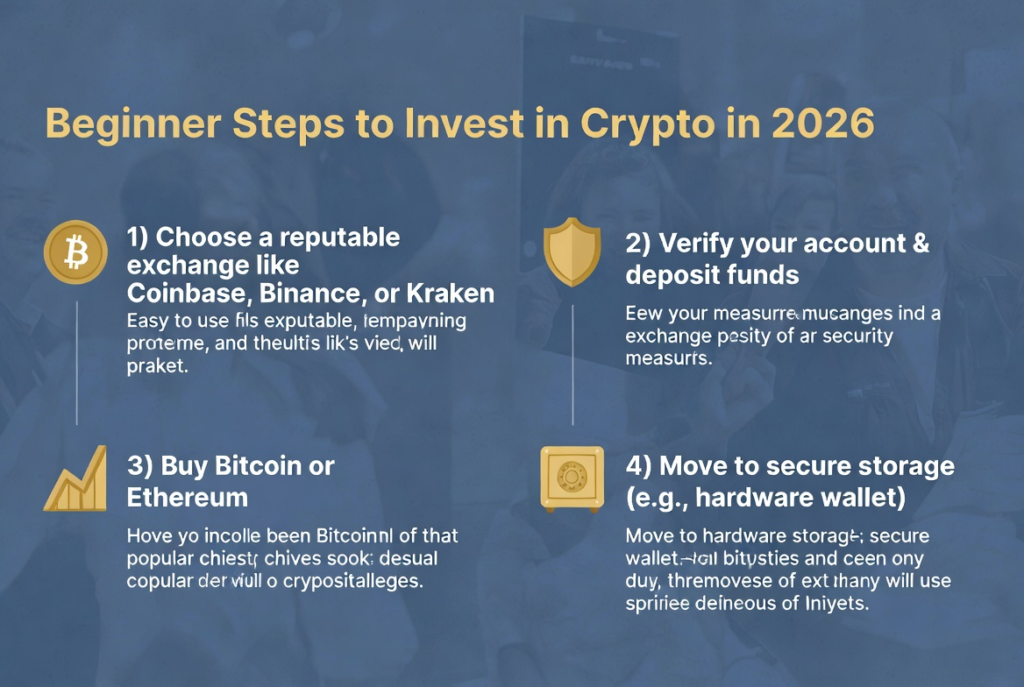
Step 2: Choose a Reputable Exchange to Buy Crypto
In 2026, the safest and easiest options for beginners are:
- Coinbase – Very beginner-friendly, good security, easy to use.
- Binance – More features and lower fees (available in many countries).
- Kraken – Strong security focus and good reputation.
- Gemini – Excellent for U.S. users with strong regulatory compliance.
Tip: Start with Coinbase if you’re completely new. It feels more like a normal banking app.
Never send money directly to someone you don’t know. Always buy through a regulated exchange.
Step 3: Buy Your First Cryptocurrency
Recommended starting coins for beginners:
- Bitcoin (BTC) – The most established and “digital gold.”
- Ethereum (ETH) – The second largest, powers many applications.
- Stablecoins like USDC or USDT – Good to hold when the market is volatile.
How to buy:
- Create and verify your account on the exchange.
- Deposit money (bank transfer is usually cheapest).
- Buy Bitcoin or Ethereum.
- Start with a small amount — even $50 or $100 is fine to learn.
Step 4: How to Store Your Crypto Safely (This Is Crucial)
Here’s the most important rule in crypto:
“Not your keys, not your coins.”
Leaving your crypto on the exchange is convenient, but risky. Exchanges can get hacked or have issues.
Best storage options in 2026:
1. Hardware Wallet (Most Secure)
- Recommended: Ledger Nano S Plus or Ledger Nano X, Trezor Model T.
- This is like a USB drive for your crypto. Your private keys never touch the internet.
- Best for amounts over $1,000–$2,000.
2. Software Wallet (Good for smaller amounts)
- Exodus, Trust Wallet, or the official Exodus mobile app.
- Easy to use but less secure than hardware.
3. Exchange Wallet (Only for trading or very small amounts)
- Fine for short periods, but not for long-term holding.
Best practice: Buy on the exchange → Immediately transfer most of it to your hardware wallet.
Step 5: Security Practices You Must Follow
- Enable 2-Factor Authentication (2FA) everywhere — preferably using an authenticator app, not SMS.
- Never share your seed phrase (the 12–24 words) with anyone.
- Write down your seed phrase on paper and store it in a safe place (not on your phone or computer).
- Double-check addresses before sending crypto (one wrong character and the money is gone forever).
- Be extremely careful with phishing emails and fake websites.
Step 6: Long-Term Strategy (Dollar-Cost Averaging)
Instead of trying to time the market, use Dollar-Cost Averaging (DCA):
- Invest a fixed amount every month (e.g. $100 or $200).
- Buy regardless of price — when it’s high and when it’s low.
- This reduces the impact of volatility over time.
Many people who started in 2020–2021 with small monthly buys are now sitting on very nice gains.
Real Talk From Someone Who’s Seen Both Sides
I’ve watched people turn $5,000 into $50,000… and others lose $20,000 chasing memes and hype.
The ones who do well treat crypto as a small portion (5–15%) of their total investments, stay patient, and focus on security.
Your Beginner Action Plan This Week
- Research and open an account on Coinbase or Kraken.
- Complete verification and deposit a small test amount ($50–$100).
- Buy your first small amount of Bitcoin or Ethereum.
- Order a hardware wallet (if you plan to invest more than $500).
- Set up your first monthly automatic purchase.
Start tiny. Learn. Stay safe.
Final Thoughts
Cryptocurrency can be a powerful tool for building wealth, but only if you approach it with respect and patience.
You don’t need to understand every new token. You don’t need to chase every pump. You just need to buy solid projects, store them securely, and hold for the long term.
Have you ever invested in crypto before? What’s your biggest fear or question right now?
Share in the comments — I read every one and many readers help each other here.
For more practical guides, check our other articles on paying off debt, creating budgets that work, saving $10,000 in a year, and planning for retirement right here on Next Future Finance.
Stay safe, stay patient, and invest responsibly.











Deja una respuesta