



Managing money feels overwhelming for most people. But here is the truth: you do not need a complicated spreadsheet, a finance degree, or a paid app to take control of your finances. You just need one simple framework that has been proven to work.
- What Is the 50/30/20 Budget Rule?
- Why the 50/30/20 Rule Works
- Step 1: Calculate Your After-Tax Income
- Step 2: Understand the Three Categories
- Real Examples: The 50/30/20 Rule at Different Income Levels
- How to Apply the 50/30/20 Rule: A Step-by-Step Process
- 5 Common Mistakes People Make With the 50/30/20 Rule
- What If the 50/30/20 Rule Does Not Fit Your Situation?
- Frequently Asked Questions
- Key Takeaways
The 50/30/20 budget rule is that framework. It is straightforward, flexible, and used by millions of people worldwide to manage their income, pay off debt, and build savings without giving up the things they enjoy.
In this guide, you will learn exactly what the 50/30/20 rule is, how it works, how to apply it to your own income with real numbers, and what to do if your situation does not fit the standard percentages.
What Is the 50/30/20 Budget Rule?
The 50/30/20 rule is a personal budgeting method that divides your after-tax income into three categories:
- 50% goes to Needs (essential expenses you cannot avoid)
- 30% goes to Wants (things you enjoy but do not strictly need)
- 20% goes to Savings and Debt Repayment (building your financial future)
The method was popularised by U.S. Senator Elizabeth Warren and her daughter Amelia Warren Tyagi in their 2005 book “All Your Worth: The Ultimate Lifetime Money Plan.” The core idea was to give people a simple, memorable framework for budgeting that did not require tracking every single purchase.
The beauty of this rule is in its simplicity. Instead of 40 budget categories, you have three. Instead of obsessing over every coffee purchase, you look at the big picture. That makes it far easier to stick to.
Why the 50/30/20 Rule Works
Most budgets fail because they are too restrictive or too complicated. The 50/30/20 rule avoids both problems.
It is permissive enough to include guilt-free spending on things you enjoy (the 30% wants category), which means you are less likely to feel deprived and give up. At the same time, it forces you to make savings automatic and non-negotiable, which is the single most important habit in personal finance.
Research consistently shows that people who automate their savings build wealth faster than those who try to save whatever is left at the end of the month. The 50/30/20 rule structures your budget so savings come first, not last.
Step 1: Calculate Your After-Tax Income
The 50/30/20 rule is based on your take-home pay, which is your income after taxes and mandatory deductions have been removed. This is the money that actually hits your bank account.
If you are a salaried employee, this is simple: look at your payslip and note the net pay figure.
If you are self-employed or freelance, calculate your average monthly income over the last three months and subtract your estimated tax obligations. A common approach is to set aside 25-30% of gross income for taxes if you are self-employed.
| Example: Calculating After-Tax Income Gross monthly salary: $5,000 Income tax (approx. 22%): -$1,100 Social security / NI: -$310 After-tax take-home pay: $3,590 This $3,590 is the number you apply the 50/30/20 rule to. |
Step 2: Understand the Three Categories
The 50% Category: Needs
Needs are essential expenses. These are things you genuinely cannot function without. If you stopped paying for them, serious consequences would follow: losing your home, losing your job, or risking your health.
Typical items in the Needs category include:
- Rent or mortgage payments
- Utility bills (electricity, water, gas, internet)
- Groceries and basic food
- Health insurance and essential medical costs
- Minimum debt repayments (credit cards, student loans)
- Transportation costs to get to work (public transport or car expenses)
- Childcare if it is required for you to work
Notice what is not on that list: subscriptions you barely use, gym memberships you feel you should have, dining out, or the premium version of apps. Those belong in Wants.
If your Needs category consistently exceeds 50%, that is a signal. It means your fixed costs are too high relative to your income, and you may need to address housing costs, transportation, or debt load before the rule can work for you.
The 30% Category: Wants
Wants are the things that make life enjoyable but are not strictly necessary for survival or employment. This is your lifestyle spending.
Examples of Wants include:
- Dining out and takeaway food
- Streaming subscriptions (Netflix, Spotify, etc.)
- Clothing beyond basic necessities
- Gym memberships and hobbies
- Travel and holidays
- Gadgets and entertainment
- Upgraded versions of things you need (a nicer car than the basic one required)
The 30% Wants category is intentionally generous. It exists because a budget that leaves no room for enjoyment is one people abandon quickly. Giving yourself permission to spend on things you enjoy within a defined limit is what makes this system sustainable long-term.
The 20% Category: Savings and Debt Repayment
This is the most important category for your long-term financial health. The 20% category covers:
- Emergency fund contributions (target: 3 to 6 months of expenses)
- Retirement contributions (pension, 401k, ISA, or equivalent)
- Investment accounts
- Extra debt repayments above the minimum
- Saving for specific goals (house deposit, car, education)
The order within this 20% matters. Financial advisors generally recommend building an emergency fund first, then tackling high-interest debt, then starting or increasing retirement contributions. But the key principle is that this 20% is set aside before you spend on anything discretionary.
Real Examples: The 50/30/20 Rule at Different Income Levels
Here is how the 50/30/20 rule looks in practice across three different monthly after-tax income levels:
| Category | Income: $2,500/mo | Income: $4,000/mo |
| 50% Needs | $1,250 | $2,000 |
| 30% Wants | $750 | $1,200 |
| 20% Savings | $500 | $800 |
| Category | Income: $6,500/mo | Income: $10,000/mo |
| 50% Needs | $3,250 | $5,000 |
| 30% Wants | $1,950 | $3,000 |
| 20% Savings | $1,300 | $2,000 |
A Real-Life Monthly Budget Example ($4,000 Take-Home)
Let us walk through what a real budget looks like for someone taking home $4,000 per month after tax.
| Expense | Amount |
| NEEDS (50% = $2,000) | |
| Rent | $1,100 |
| Groceries | $300 |
| Electricity and water | $120 |
| Internet | $60 |
| Public transport / car fuel | $180 |
| Health insurance | $150 |
| Minimum loan repayment | $90 |
| Needs Subtotal | $2,000 |
| WANTS (30% = $1,200) | |
| Dining out and coffee | $250 |
| Streaming services | $50 |
| Gym membership | $40 |
| Clothing and personal care | $200 |
| Entertainment / hobbies | $200 |
| Weekend travel | $300 |
| Miscellaneous | $160 |
| Wants Subtotal | $1,200 |
| SAVINGS (20% = $800) | |
| Emergency fund top-up | $300 |
| Retirement contribution | $300 |
| Extra loan repayment | $200 |
| Savings Subtotal | $800 |
| TOTAL | $4,000 |
How to Apply the 50/30/20 Rule: A Step-by-Step Process
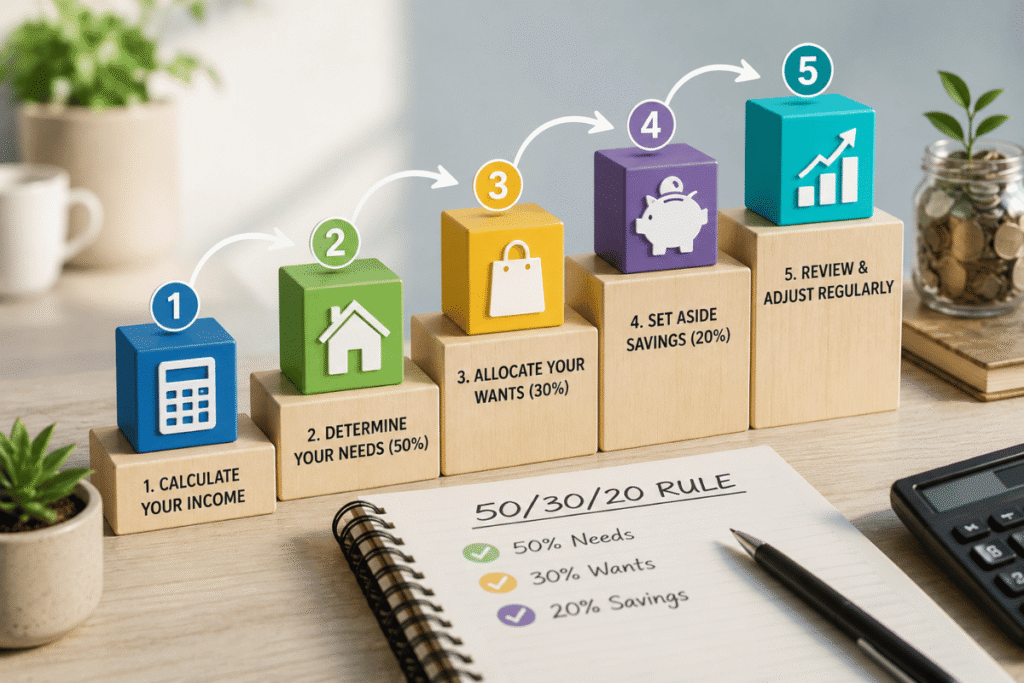
Step 1: Calculate your monthly after-tax income
Use your payslip net pay figure. If income varies, average the last three months.
Step 2: Multiply by 0.50, 0.30, and 0.20
These three numbers are your spending limits for each category. Write them down before you do anything else.
Step 3: List all your current expenses
Go through your last two to three bank statements and categorise every expense as a Need, Want, or Saving. Be honest. A gym membership you use twice a month is a Want, not a Need.
Step 4: Compare your actual spending to your targets
Most people discover at this step that their Needs or Wants are over budget. That is normal. The point is to see the gap clearly so you can make intentional decisions about where to cut.
Step 5: Adjust and automate
Set up automatic transfers on payday so that your 20% savings allocation moves to a separate account before you can spend it. What you never see in your spending account, you never miss.
Step 6: Review monthly
Check your progress at the end of each month. This does not need to take more than 15 minutes. The goal is awareness, not perfection.
5 Common Mistakes People Make With the 50/30/20 Rule
Mistake 1: Using Gross Income Instead of Net Income
The rule is based on take-home pay, not your salary before tax. Using your gross salary inflates all three categories and makes the budget unworkable. Always start with the money that actually reaches your account.
Mistake 2: Misclassifying Wants as Needs
Subscriptions, gym memberships, and premium phone plans are almost always Wants, not Needs. Be ruthlessly honest when categorising. If losing it would not put your job or health at risk, it is a Want.
Mistake 3: Ignoring the Savings Category When Money Is Tight
When budgets feel squeezed, savings are usually the first thing people cut. This is the opposite of what works. Even saving $50 or $100 per month consistently builds a habit and an emergency fund that prevents future financial crises.
Mistake 4: Treating It as a One-Time Exercise
The 50/30/20 rule only works if you revisit it regularly. Income changes, expenses change, and life changes. Review your budget every month and do a deeper audit every six months.
Mistake 5: Giving Up When the Numbers Do Not Work Out Perfectly
Most people cannot hit 50/30/20 exactly in month one. That is fine. The rule is a target and a direction, not a rigid law. Getting to 55/30/15 is still a massive improvement over having no budget at all.
What If the 50/30/20 Rule Does Not Fit Your Situation?
The 50/30/20 rule is a guideline, not a prescription. Your circumstances may require a different split. Here are some common adjustments:
| Situation | Suggested Adjustment |
| High cost-of-living city | Try 60/20/20 (more for needs, less for wants) |
| Significant debt to pay off | Try 50/20/30 (flip wants and savings) |
| Low income, building emergency fund | Try 60/10/30 temporarily |
| High income, wants naturally low | Increase savings beyond 20% |
| Freelancer with variable income | Base on your lowest recent month |
The point is not to follow the 50/30/20 rule perfectly. The point is to be intentional with your money and to ensure savings are a built-in part of your financial life, not an afterthought.
Frequently Asked Questions
Is the 50/30/20 rule still relevant in 2026?
Yes. While inflation has made the Needs category harder to keep under 50% in high cost-of-living areas, the underlying principle remains sound: allocate income intentionally across living expenses, lifestyle spending, and savings. The percentages can be adjusted; the three-category framework is universally useful.
What if my rent alone takes up more than 50% of my income?
This is a very common problem, particularly for younger people in major cities. If housing alone exceeds 50% of your take-home pay, you have a structural income-to-cost problem that the budgeting rule cannot solve on its own. Options include increasing income (side work, asking for a raise), reducing housing costs (a flatmate, moving areas), or temporarily adjusting the percentages until your income grows.
Should I put savings or debt repayment first?
This depends on interest rates. High-interest debt (credit cards at 18-25% APR) should generally be tackled before investing, because the guaranteed return from eliminating that debt exceeds likely investment returns. However, always maintain a small emergency fund (at least $1,000) even while paying down debt, so that an unexpected expense does not send you back into debt immediately.
Can I use the 50/30/20 rule if I am paid weekly or bi-weekly?
Yes. Simply calculate your monthly income equivalent (weekly pay x 52 divided by 12, or bi-weekly pay x 26 divided by 12) and apply the percentages to that monthly figure. Then manage your expenses on a monthly basis rather than per paycheck.
Does the 50/30/20 rule account for taxes?
The rule uses after-tax income, so taxes are not part of the calculation. If you are self-employed, set aside your tax obligations before applying the 50/30/20 split. Think of tax savings as a separate pre-budget deduction.
What is the best app to track the 50/30/20 budget?
Several budgeting apps support the 50/30/20 framework including YNAB (You Need a Budget), Mint, and Monarch Money. However, a simple spreadsheet or even pen and paper works perfectly well. The tool matters far less than the habit of reviewing your spending regularly.
Key Takeaways
| Summary: The 50/30/20 Budget Rule 50% of after-tax income goes to Needs (rent, groceries, bills, minimum debt payments) 30% goes to Wants (dining out, subscriptions, hobbies, travel) 20% goes to Savings and extra debt repayment Always base the calculation on take-home pay, not gross salary. Automate your 20% savings on payday so it happens before you can spend it. Adjust the percentages if your situation demands it. The framework matters more than the exact numbers. Review your budget monthly. Awareness is the foundation of financial progress. |
The 50/30/20 rule is not magic. It will not make you rich overnight or eliminate debt in a month. What it will do is give you a clear, honest picture of where your money goes and a practical framework for directing it toward the life you want to build.
Start today. Calculate your after-tax income, multiply by 0.50, 0.30, and 0.20, and compare those numbers against what you actually spent last month. That single exercise will teach you more about your finances than months of vague worry.