Quantum computing will eventually be able to break some of the encryption that protects online banking, but it cannot do that today, and your money is not at immediate risk. Banks, governments, and big tech companies are already switching to new quantum-resistant security, and a few simple habits can protect you in the meantime.
- What Is Quantum Computing and Why Does It Threaten Banks?
- When Could Q-Day Happen? What We Know in 2026
- What Is Actually at Risk (and What Isn’t)
- How Banks and Governments Are Preparing
- What You Can Do Today to Protect Your Money
- How Quantum Will Also Help Banking
- Frequently Asked Questions About Quantum Computing and Banking
- Can a quantum computer hack my bank account today?
- What does Q-Day mean?
- Is my money safe in a bank if Q-Day happens?
- Will quantum computers break Bitcoin?
- What is post-quantum cryptography in simple terms?
- Should I change my passwords because of quantum computing?
- Is “harvest now, decrypt later” a threat to ordinary people?
- Conclusion: Prepare Calmly, Not Fearfully
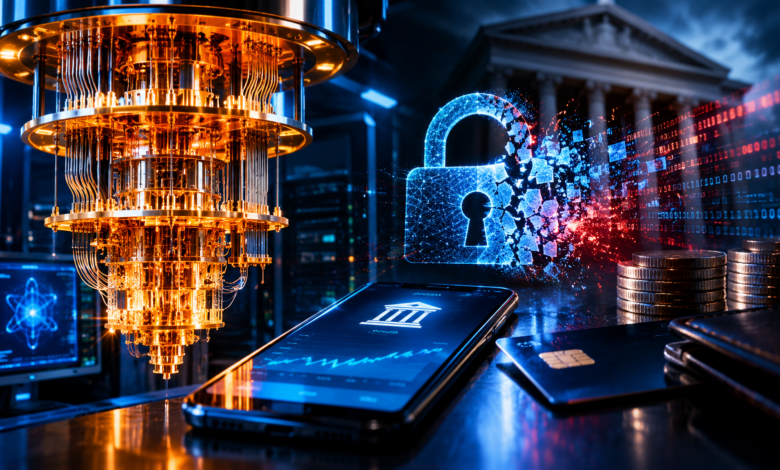
This guide explains what quantum computers are, why they worry security experts, what “Q-Day” really means, and what you can do right now without any technical skill.
What Is Quantum Computing and Why Does It Threaten Banks?
Quantum computing is a new way of processing information that uses the strange rules of physics at the smallest scales. It will not replace your laptop or phone. Instead, it is expected to be very good at a narrow set of problems, and unfortunately, one of those problems is breaking the math that keeps your bank account private.
How a Quantum Computer Differs From a Regular Computer
A regular computer stores information as bits, and each bit is either 0 or 1. A quantum computer uses qubits, which can exist in a blend of states until they are measured. When many qubits are linked together in the right way, certain calculations that would take a regular computer longer than the age of the universe could, in theory, be finished in hours or days.
That does not mean quantum computers are faster at everything. They are not useful for streaming video, checking email, or running a banking app. They shine at specific tasks, such as simulating molecules, optimizing complex systems, and, most importantly for this article, factoring very large numbers.
Today’s quantum machines are real but limited. Their qubits are fragile and make many errors, and building a machine large and stable enough to threaten modern encryption is still an enormous engineering challenge.
How Today’s Encryption Protects Your Bank Account
Every time you open a banking app, your phone and the bank’s servers set up a secure connection. Two kinds of encryption work together to make that happen:
- Public-key cryptography (such as RSA and elliptic curve cryptography) lets two strangers agree on a secret and verify each other’s identity. It protects the “handshake” and digital signatures.
- Symmetric encryption (such as AES) scrambles the actual data once the secure connection is open. It is fast and strong.
Public-key systems like RSA rely on a simple fact: multiplying two huge prime numbers is easy, but starting with the result and finding the original primes is practically impossible for ordinary computers. That one-way difficulty is what locks the door.
In 1994, mathematician Peter Shor showed that a large enough quantum computer could solve this problem efficiently. In other words, a powerful quantum machine could, in principle, pick the lock that protects most of the internet’s public-key security.
What Is Q-Day?
Q-Day is the name security experts give to the day a quantum computer becomes powerful enough to break widely used public-key encryption in practice. Nobody knows exactly when it will arrive, or whether it will be announced publicly. Some experts worry that a government or criminal group could reach it quietly.
The important point is that Q-Day is a planning deadline, not a prediction of disaster. Banks and security teams are moving now precisely so that the day passes without a crisis.
When Could Q-Day Happen? What We Know in 2026
Honest answer: nobody can say for sure. Estimates have shifted over the years, and they have generally moved closer, not further away.
Why Estimates Keep Getting Shorter
In 2019, researchers estimated that breaking RSA-2048, a common standard, would require around 20 million noisy qubits. In 2025, a Google researcher published a new analysis suggesting that fewer than one million noisy qubits could do the job in under a week. That is roughly a twentyfold reduction in the hardware needed, thanks to smarter algorithms and error correction.
People in the industry have noticed. Google has said it aims to complete its own move to post-quantum cryptography by 2029, which is well ahead of the 2035 target in U.S. government guidance.
Expert opinion remains wide. A survey by the Global Risk Institute found that experts put the chance of Q-Day arriving by 2034 at roughly one in five to one in three, rising to more than 60 percent by 2044. Some cryptographers think it could take much longer, and a few doubt it will happen at all. That uncertainty is exactly why preparation starts early.
“Harvest Now, Decrypt Later”: The Risk That Already Exists
There is one part of the quantum threat that is real today. Attackers can record encrypted traffic now and store it, then decrypt it years later when quantum computers are available. This is called “harvest now, decrypt later.”
For most everyday data, that does not matter. Your coffee purchase from 2026 will not be valuable in 2036. But for information that must stay secret for decades, such as government documents, medical files, trade secrets, and some identity records, the clock has already started.
| Milestone | What it means | Rough timing |
|---|---|---|
| Shor’s algorithm published | Proof that quantum machines could break RSA and similar systems | 1994 |
| NIST finalizes first post-quantum standards | Official quantum-resistant algorithms become available | August 2024 |
| Lower qubit estimates published | Breaking RSA-2048 may need under 1 million noisy qubits | 2025 |
| Big tech migration targets | Companies such as Google aim to finish moving to new cryptography | Around 2029 |
| NIST target to retire vulnerable algorithms | Older public-key methods phased out in U.S. guidance | By 2035 |
| Expert survey range for Q-Day | Roughly 19 to 34 percent chance by 2034, over 60 percent by 2044 | 2034 to 2044 |
What Is Actually at Risk (and What Isn’t)
Headlines about “quantum apocalypse” make it sound like your savings could vanish overnight. The reality is more specific. Different parts of the financial system face different levels of risk.
Your Account Balance and Deposit Insurance
Your bank balance is a record in the bank’s ledger. A quantum computer does not reach into a database and erase numbers by itself. The danger is that attackers could use broken encryption to impersonate you or the bank, or to tamper with messages.
If you hold money at a U.S. bank or credit union, deposit insurance still applies. The FDIC and NCUA each protect up to $250,000 per depositor, per institution, per ownership category if the institution fails. That protection does not depend on encryption.
Data in Transit and Stored Data
When you log in, the secure “handshake” uses public-key cryptography, which is the part quantum computers could eventually break. The data stream itself uses symmetric encryption such as AES-256, which is considered much more resistant. Quantum computers could weaken symmetric encryption somewhat, but doubling key sizes is enough to keep it safe.
That is why experts focus on replacing the handshake and signature methods first. Fixing those is the heart of the global migration.
Digital Signatures and Payments
Signatures prove that a payment instruction really came from you or your bank. If an attacker could forge signatures, they could in theory fake transactions, software updates, or banking certificates. Many payment networks, card systems, and banking apps rely on signature methods that will need to be upgraded.
This matters even more as money moves faster. As we explain in our guide to instant payments and FedNow, real-time transfers are final, so strong authentication has to work flawlessly.
Bitcoin and Other Cryptocurrencies
Cryptocurrencies are among the most exposed assets, because they rely on public-key signatures and many wallets reveal their public keys on the blockchain. A January 2026 report from the Citi Institute estimated that about a quarter of all bitcoin, roughly 4.5 to 6.7 million coins, sits in addresses that are potentially quantum-exposed.
Upgrading a decentralized network is harder than updating a bank, because changes require broad agreement among users. If you hold crypto, this is a topic worth following. For background on how governments are thinking about digital money, see our article on why the U.S. banned a digital dollar.
| What you own or use | Level of quantum risk | Why |
|---|---|---|
| Money in an insured bank account | Low | Insurance and bank controls do not depend on one algorithm |
| Online banking login and app traffic | Medium over time | Handshake methods need upgrading, and banks are working on it |
| Card and payment network signatures | Medium over time | Many systems rely on older signature methods |
| Long-term sensitive records | Higher | Could be harvested now and read later |
| Bitcoin in exposed addresses | Higher | Public keys may be visible on the blockchain |
| Cash and physical assets | None | Not protected by digital encryption |
How Banks and Governments Are Preparing
The good news is that the fix already exists. The challenge is rolling it out across millions of systems.
The New Standards: Post-Quantum Cryptography
Post-quantum cryptography (PQC) means encryption methods designed to resist both regular and quantum computers. Unlike quantum technology, PQC runs on ordinary hardware and software, which makes it practical to deploy.
In August 2024, the U.S. National Institute of Standards and Technology (NIST) published its first three PQC standards after an eight-year global competition:
- FIPS 203 (ML-KEM): for establishing secure connections.
- FIPS 204 (ML-DSA): for digital signatures.
- FIPS 205 (SLH-DSA): a backup signature method built on different math.
NIST later selected an additional backup method for key exchange and continues to finalize further standards. Its transition guidance calls for retiring today’s vulnerable public-key methods by 2035.
What Tech Companies Have Already Done
You may already be using quantum-resistant protection without knowing it. Major web browsers have enabled hybrid key exchange, which combines a classic method with a post-quantum one. Apple upgraded iMessage with a post-quantum protocol in 2024, and Signal added quantum-resistant key setup in 2023. Large content networks now protect a significant share of their traffic this way.
The “hybrid” approach is a smart safety net: if either method turns out to be weak, the other still protects you.
What Banks and Regulators Are Doing
Financial regulators and industry groups have moved the topic from the lab to the boardroom. The G7 Cyber Expert Group, which advises finance ministers and central bank governors, published guidance in 2024 urging the financial sector to plan for the transition. The Bank for International Settlements has also published research on the risk. In the U.S., the Quantum Computing Cybersecurity Preparedness Act requires federal agencies to move toward post-quantum cryptography.
Some banks have gone further and run pilots. HSBC, for example, trialed a quantum-secured network in London in 2023, and several large banks have publicly said they are building inventories of where encryption is used.
Still, progress is uneven. Many organizations have not even finished listing which systems use vulnerable encryption, and migrations can take years. This is called crypto-agility: designing systems so that algorithms can be swapped out without rebuilding everything.
Quantum Key Distribution vs. Post-Quantum Cryptography
You may also hear about quantum key distribution (QKD), which uses physics to exchange keys. It is interesting, but it needs special hardware and fiber links, so it is limited to specific uses. Most security agencies recommend PQC as the main, scalable solution for banks and consumers.
| Approach | How it works | Needs new hardware? | Best use |
|---|---|---|---|
| Post-quantum cryptography | New math that quantum computers cannot easily break | No, software updates | Banking apps, websites, payments, messaging |
| Quantum key distribution | Physics-based key exchange over special links | Yes | Specialized high-security links |
| Longer symmetric keys (AES-256) | Larger keys keep stored data safe | No | Encrypting stored data and traffic |
What You Can Do Today to Protect Your Money
You do not need to understand lattices or qubits to be ready. Most of your protection will come from your bank’s upgrades. Your job is to stay current and avoid the weak links you can control.
1. Switch to Passkeys and Strong Multi-Factor Authentication
Passwords are already the weakest link in banking security, and quantum risk is not even needed to explain why. Passkeys replace passwords with cryptographic keys stored on your device, which makes phishing far harder. As our guide on passkeys and your bank account explains, they are a big upgrade, and providers are working to make them quantum-resistant over time.
Where passkeys are not offered, use an authenticator app instead of text message codes.
2. Keep Your Phone, Browser, and Banking App Updated
Post-quantum protection arrives through ordinary software updates. Turn on automatic updates for your operating system, browser, and banking apps. This is the single easiest way to benefit from new security without lifting a finger.
3. Be Careful With Long-Lived Sensitive Data
Because of “harvest now, decrypt later,” think about what sensitive information you share and store. Avoid sending scans of passports, tax returns, or ID documents by regular email. Delete old files you no longer need, and use services that clearly describe how they encrypt stored data.
4. Ask Your Bank and Your Providers
You have every right to ask. Try a simple question to your bank or credit union: “Do you have a plan to move to post-quantum encryption?” You may get a generic answer, but customer questions push institutions to prioritize it. Also look at any security updates your bank publishes.
5. If You Hold Crypto, Take Extra Care
Use wallets from reputable developers that publish upgrade plans, avoid reusing addresses, and follow the discussion in the community around quantum-resistant upgrades. Never move funds in a hurry because of a scary headline.
6. Watch Out for Quantum-Themed Scams
Whenever a new technology makes headlines, scammers use it as bait. Be suspicious of any message that offers “quantum-proof” investments, “quantum AI” trading bots with guaranteed returns, or urgent warnings that you must move your money to a “quantum-safe account.” Your bank will never ask you to do that. If anything pressures you to act quickly, treat it as a red flag. Our article on deepfake scams and AI voice cloning shows the verification habits that stop most of these attacks.
| Action | Time needed | Cost | What it protects against |
|---|---|---|---|
| Turn on passkeys or app-based 2FA | 15 minutes | Free | Account takeover and phishing |
| Enable automatic updates | 5 minutes | Free | Outdated security, including future PQC upgrades |
| Clean out old sensitive files | 30 minutes | Free | Long-term data exposure |
| Ask your bank about its quantum plan | 10 minutes | Free | Helps you choose a prepared provider |
| Review crypto wallet practices | 30 minutes | Varies | Quantum-exposed addresses |
| Learn the quantum scam red flags | 10 minutes | Free | Investment and impersonation fraud |
How Quantum Will Also Help Banking
It is easy to focus on the threat, but quantum technology may bring benefits too. Banks are exploring quantum methods for portfolio optimization, fraud detection, and risk modeling, where the ability to evaluate huge numbers of possibilities could help. Most of this work is still experimental, but it explains why financial institutions are investing in the technology at the same time as they defend against it.
For everyday customers, the likely impact is invisible: better security, fewer fraud losses, and smoother services. If you want to see how technology is already changing your bank app, read our piece on open banking and connected finance apps.
Frequently Asked Questions About Quantum Computing and Banking
Can a quantum computer hack my bank account today?
No. Current quantum computers are far too small and error-prone to break the encryption used by banks. The risk is about the future, which is why banks and governments are upgrading now.
What does Q-Day mean?
Q-Day is the point when a quantum computer can break widely used public-key encryption like RSA and elliptic curve cryptography. Estimates range from the early 2030s to the 2040s or later, and nobody knows for sure.
Is my money safe in a bank if Q-Day happens?
Insured deposits remain protected by deposit insurance up to the legal limits, and banks are upgrading their systems well before that point. Your main job is to stay alert to fraud and keep your accounts secure.
Will quantum computers break Bitcoin?
They could threaten the signature method Bitcoin uses, particularly for coins in addresses whose public keys are already visible. The network could be upgraded to quantum-resistant methods, but doing so requires broad coordination. Treat it as a long-term risk to watch rather than a reason to panic.
What is post-quantum cryptography in simple terms?
It is a new family of encryption methods built on math problems that even quantum computers are not known to solve quickly. It runs on normal devices and is delivered through software updates.
Should I change my passwords because of quantum computing?
You do not need to change passwords because of quantum risk alone. But you should use unique passwords, a password manager, and passkeys or app-based two-factor authentication wherever possible, because that protects you against today’s threats.
Is “harvest now, decrypt later” a threat to ordinary people?
For most everyday data, the risk is low, because it will not matter in ten years. It matters more for information that must stay private for decades, such as identity documents and medical records. Limit what you share and store.
Conclusion: Prepare Calmly, Not Fearfully
Quantum computing is one of the most important technology shifts of the decade, and it will force the financial system to change how it protects data. But the story is not a disaster movie. The solutions exist, the standards are published, and the largest technology companies and banks are already moving.
For you, the practical steps are simple. Use passkeys or an authenticator app, keep your devices updated, be careful with sensitive files, ask your bank about its plans, and stay skeptical of anyone selling “quantum” investments.
If you remember one idea, make it this: Q-Day is a deadline for institutions, not a panic button for you. Take ten minutes this week to turn on stronger login protection and update your banking app, and you will already be ahead of most people.
This article is for general information only and is not financial, legal, security, or investment advice. Technology timelines, standards, and bank practices change quickly, so confirm details with your bank and official sources before you act.