
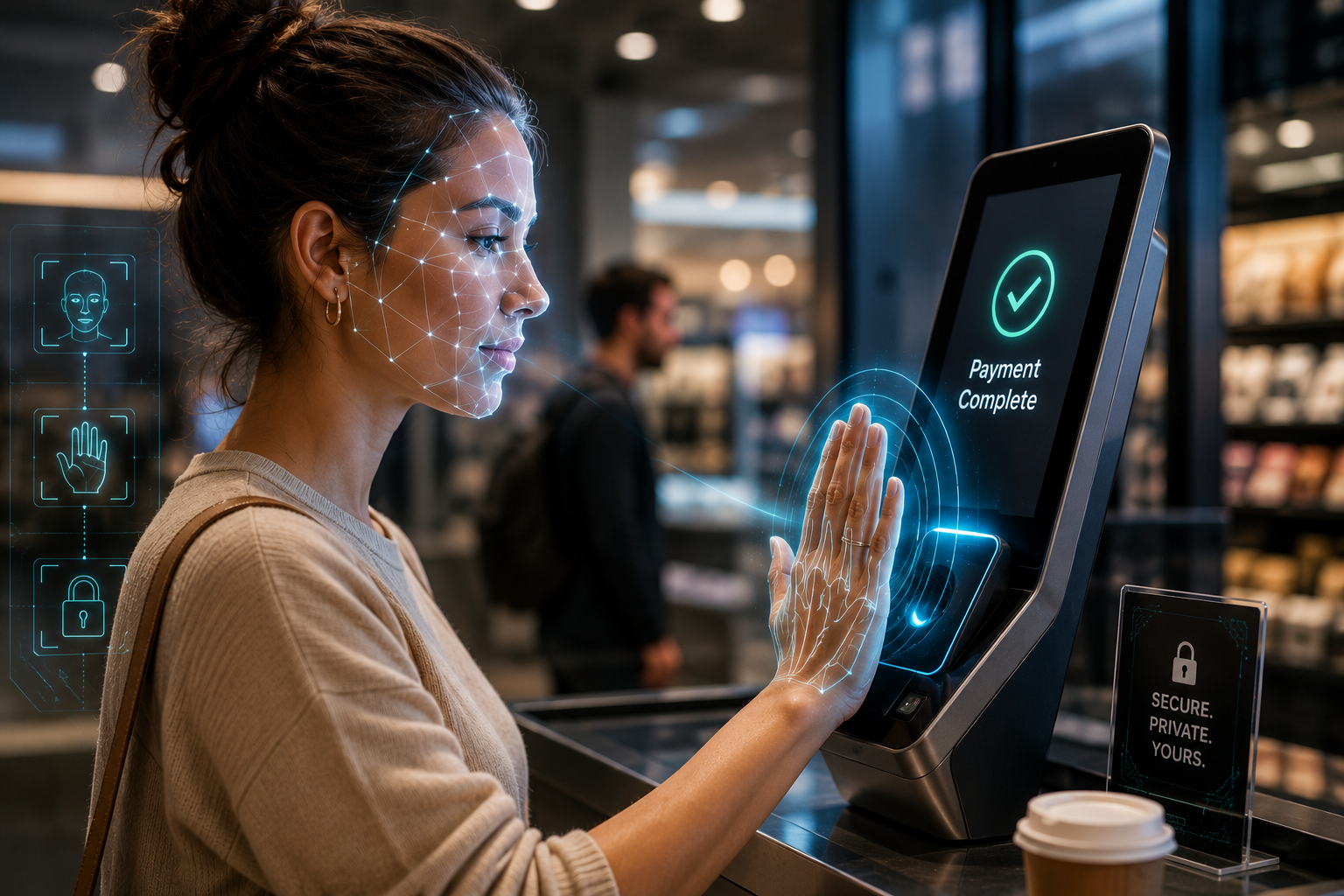

A woman walks into her regular grocery store, picks up a week’s worth of shopping, and walks out again without touching her phone, her wallet, or a single card reader. At the exit, a small sensor scans the veins in her palm, matches it against a payment profile she set up months earlier, and the receipt lands in her email before she’s back in her car. No tap. No PIN. No “insert or swipe.” Just a hand, held over a scanner for less than a second.
- What “Biometric Payments” Actually Means
- The Technology Behind the Scan
- Why Banks and Retailers Are Racing to Adopt This
- Where Biometric Payments Already Exist
- Palm vs. Face vs. Fingerprint vs. Iris: How the Methods Compare
- The Real Security Case: Why Biometrics Can Be Safer Than a Card
- The Real Risk Case: What Happens When Biometric Data Leaks
- Consent, Data Ownership, and the Questions Regulators Are Still Answering
- How This Connects to the Rest of the Fintech Shift
- Biometric Payments and Your Kids: What Parents Should Know
- A Practical Framework: Should You Opt In?
- A Checklist Before You Enroll Your Biometrics Anywhere
- Frequently Asked Questions
- The Bottom Line
- Sources
That scene isn’t a prototype demo anymore. It’s a Tuesday afternoon in a growing number of supermarkets, stadiums, transit systems, and even bank branches around the world. Biometric payments — using your face, your palm, your fingerprint, or even the unique pattern of your iris to authorize a purchase — have moved from novelty to infrastructure faster than almost any other shift in how money changes hands. And like most quiet infrastructure changes, most people are using it, or standing next to someone using it, long before they’ve actually thought through what it means.
This piece is a practical, no-hype walkthrough of what biometric payments actually are, how the technology behind them works, why banks and retailers are racing to roll them out, and — just as important — what genuine risks and open questions come attached to letting your body become your payment credential. If you’ve read our breakdown of AI-powered financial scams and deepfake fraud, you already know identity verification is under serious strain right now. Biometric payments sit right at the center of that tension: they’re being sold as the solution to identity fraud, while simultaneously creating an entirely new category of data that, if compromised, can’t simply be reset like a password.
What “Biometric Payments” Actually Means
At its core, a biometric payment replaces something you have (a card) or something you know (a PIN or password) with something you are. Instead of presenting a physical token or reciting a memorized code, you present a unique, measurable feature of your own body — a fingerprint, the geometry of your face, the vein pattern in your palm, or the structure of your iris — and a system checks that feature against a stored profile to confirm you’re authorized to complete the transaction.
It’s worth separating two things that often get lumped together. The first is biometric authentication, which most people already use every day — unlocking a phone with Face ID or a fingerprint, for instance. That’s been mainstream for close to a decade. The second, newer shift is biometric payment authorization at the point of sale — using that same kind of scan not just to unlock a device, but to directly trigger a transfer of money, in person, without a card, phone, or wallet ever coming out of your pocket. That second category is what’s expanding rapidly in 2026, and it’s a meaningfully bigger step, because it turns your body itself into the final link in the payment chain, not just the key to unlock a device that then makes the payment.
The Technology Behind the Scan
Biometric payment systems generally follow the same basic sequence, regardless of which body feature they use.
Enrollment. You register with a bank, a retailer’s loyalty program, or a dedicated biometric payment provider by scanning the relevant feature — your palm, your face, or your fingerprint — usually multiple times from different angles to build an accurate reference profile. This enrollment step is typically linked to an existing card or bank account, so the biometric scan doesn’t replace your underlying account; it replaces the method you use to authorize a transaction from it.
Template creation, not photo storage. This is the detail most people misunderstand, and it matters. Reputable biometric payment systems don’t store an actual photo or fingerprint image in a database somewhere. Instead, the scan is converted into a mathematical representation — a “template” — made up of measurements and ratios (the distance between features, vein branching patterns, ridge structures) that can’t be reverse-engineered back into a usable image in most well-designed systems. When you pay later, a fresh scan is taken, converted into the same kind of template, and compared mathematically to the stored one. A match above a certain confidence threshold authorizes the transaction.
Matching and authorization. Once matched, the system sends a standard payment authorization request to your linked card network or bank, exactly as if you’d tapped a card or entered a PIN — the biometric layer sits in front of the existing payment rails, rather than replacing them entirely. This is an important nuance: biometric payments, in their current form, are mostly a new front door onto the same banking infrastructure that’s always existed, not a wholesale replacement of it.
Liveness detection. To prevent someone from using a photo, a recording, or a mold of a fingerprint to spoof the system, most serious biometric payment systems include liveness checks — subtle movement detection, depth-sensing cameras, or blood-flow detection under the skin for palm scanners — specifically designed to distinguish a living person from a static reproduction. This is the same category of defense discussed in our piece on deepfake-driven financial fraud, and it’s very much part of the same ongoing arms race between verification technology and increasingly sophisticated spoofing attempts.
Why Banks and Retailers Are Racing to Adopt This
There’s real commercial logic driving this rollout, beyond the “cool new tech” factor.
Speed and checkout friction. Every second removed from a checkout line has measurable value at scale for a retailer processing thousands of daily transactions. A palm or face scan is consistently faster than fumbling for a card, entering a PIN, or unlocking a phone for a tap payment, and retailers have been explicit that friction reduction, not novelty, is the main driver behind pilot programs.
Fraud reduction on the retailer side. Card-present fraud, chargebacks, and stolen-card usage cost retailers and banks billions annually. A biometric can’t be “lost,” left in a coat pocket, or skimmed the same way a physical card can, which makes it structurally harder — though, as covered below, not impossible — to commit certain categories of point-of-sale fraud.
Reduced dependence on physical infrastructure. For transit systems in particular, biometric entry removes the need for physical card issuance, replacement, and the customer-service overhead that comes with lost or malfunctioning transit cards, while still working for tourists and infrequent riders who can enroll on the spot.
Loyalty and personalization data. It would be incomplete to leave this out: biometric enrollment also gives retailers an extremely reliable way to link a specific, unique individual to their purchase history across visits, which has obvious value for personalized marketing and loyalty programs — a commercial incentive that sits alongside, and sometimes in tension with, the security pitch.
Where Biometric Payments Already Exist
This isn’t a future-tense trend. Biometric payment systems are already live and expanding across several sectors.
Grocery and retail. Major grocery chains in the US, UK, and parts of Asia have rolled out palm-scanning payment terminals at checkout, typically opt-in and linked to an existing loyalty account or payment card during enrollment.
Transit systems. Several major metro and rail systems have piloted or launched facial-recognition-based fare payment, allowing riders to walk through a gate without tapping a card or phone at all, with fares deducted automatically from a linked account.
Stadiums and large venues. Concert venues and sports stadiums have adopted facial-recognition and palm-based entry-and-pay systems, combining ticketing, identity verification, and payment authorization for concessions into a single scan, which venues frame primarily as a security and crowd-flow improvement.
Banking and ATMs. A number of banks have introduced fingerprint- or facial-recognition-based ATM authentication, allowing withdrawals without a physical card, aimed particularly at reducing card-skimming fraud at unattended machines.
Cross-border and airport payments. Some airports and duty-free retailers have integrated biometric payment with existing biometric border-control systems, allowing a single facial scan to handle identity verification and purchase authorization together during international travel.
Palm vs. Face vs. Fingerprint vs. Iris: How the Methods Compare
Not all biometric payment methods are equal, and the differences matter for both convenience and security.
| Method | How it works | Strengths | Weaknesses |
|---|---|---|---|
| Palm scan | Reads the unique vein pattern beneath the skin using near-infrared light | Very hard to spoof (veins aren’t visible or photographable); no mask or photo risk; contactless | Requires dedicated hardware; less familiar to first-time users |
| Facial recognition | Maps facial geometry using depth-sensing or standard cameras | Fastest, fully hands-free; widely deployed already via phones | More vulnerable to high-quality deepfake or mask spoofing without strong liveness detection; raises the most public privacy concern |
| Fingerprint | Reads ridge patterns via optical or capacitive sensors | Extremely mature, well-understood technology; cheap hardware | Can be affected by wet, dirty, or worn fingers; historically the most-spoofed biometric via lifted prints |
| Iris scan | Maps the unique pattern in the colored part of the eye | Extremely high accuracy; very hard to replicate | Requires precise positioning and specialized hardware; least common in retail settings so far |
Palm scanning has emerged as the fastest-growing method for point-of-sale payments specifically, largely because vein patterns sit beneath the skin’s surface, making them essentially impossible to capture from a photo or a fingerprint left on a glass — a meaningfully higher bar for a would-be attacker than facial recognition currently offers without robust liveness detection layered on top.
The Real Security Case: Why Biometrics Can Be Safer Than a Card
It’s worth being fair to the genuine upside here, because the security argument isn’t just marketing.
A physical card can be stolen, cloned, or skimmed, and a PIN can be observed, guessed, or phished. A biometric, by contrast, isn’t something you carry that can be physically lost, and it isn’t something you type that can be shoulder-surfed or intercepted by a keylogger. For a huge share of everyday, low-value, in-person transactions — the exact use case biometric payments target first — this genuinely closes off entire categories of common fraud.
Biometric payments also sidestep a specific, growing risk: card-skimming devices at gas pumps, ATMs, and point-of-sale terminals, which remain a stubbornly persistent form of fraud precisely because they exploit the physical, swipeable nature of a card’s magnetic stripe or chip. A palm or face that authorizes a transaction through a secure, liveness-checked terminal doesn’t have an equivalent physical skimming vulnerability.
The Real Risk Case: What Happens When Biometric Data Leaks
Here’s the part that deserves the most honest scrutiny, and the part most retail rollout marketing tends to underplay.
You can’t reset your face. This is the single most important distinction between biometric credentials and every other form of payment security. If your card number leaks, the bank cancels it and issues a new one. If your password leaks, you change it. If your palm-vein template or facial-recognition profile leaks from a retailer’s database, there’s no equivalent reset — you have exactly one face and two palms for your entire life, and any system that stored a compromised template now has a permanently compromised piece of your identity on record somewhere, even if you switch payment providers going forward.
Template theft doesn’t require the biometric feature itself. A well-designed system stores an irreversible mathematical template rather than a raw image, which meaningfully reduces — but doesn’t eliminate — the risk. Poorly secured systems, older implementations, or providers cutting corners on encryption can and have stored more reversible data than they should, and any breach of that data carries permanent consequences in a way a breached card database simply doesn’t.
Centralization risk. As more retailers, banks, and transit systems adopt biometric payments, there’s a real question about how many separate organizations end up holding a template tied to your face or palm, and how consistently each of them secures it. A single weak link in that expanding chain — one retailer with lax security practices — can expose biometric data that then has implications well beyond that one retailer’s own systems.
Sophisticated spoofing is improving too. As discussed in detail in our deepfake and voice-cloning fraud analysis, the same generative AI tools driving synthetic voice and video fraud are also being pointed at biometric spoofing — high-resolution 3D-printed masks, AI-upscaled photos, and synthetic video feeds designed specifically to defeat facial-recognition liveness checks. This is precisely why palm-vein scanning, which reads a feature invisible to a camera or a printed mask, is gaining ground faster than facial recognition for payment authorization specifically, even though facial recognition remains more common for simple device unlocking.
Consent, Data Ownership, and the Questions Regulators Are Still Answering
Biometric payments sit in a genuinely unsettled area of consumer protection law, and it’s worth understanding where the open questions actually are rather than assuming they’ve all been resolved.
Who owns the template once it’s created? In most current implementations, the retailer or payment processor that captured the biometric scan retains the resulting template, subject to whatever privacy policy the customer agreed to at enrollment — often without fully reading it, which is true of privacy policies generally but carries higher stakes here given the irreversibility problem described above.
How long is the data retained, and what happens if you opt out later? Regulations vary significantly by jurisdiction. Some regions have specific biometric privacy laws requiring clear consent, defined retention limits, and a genuine deletion process if a customer withdraws consent; others have far less specific guidance, leaving retention practices largely up to individual companies’ own policies.
Can biometric payment data be subpoenaed, sold, or shared with third parties? This depends heavily on both jurisdiction and the specific terms a customer agreed to at enrollment — another reason it’s worth actually reading the biometric consent terms rather than tapping through them, even though almost nobody does in practice.
Regulators in several regions have begun treating biometric data as a distinct, higher-sensitivity category deserving stronger legal protection than typical financial data, precisely because of its irreversibility, and this area is likely to see continued regulatory development as adoption grows — it’s a genuinely moving target rather than a settled framework, and worth checking current local rules before enrolling.
How This Connects to the Rest of the Fintech Shift
Biometric payments don’t exist in isolation — they’re one more piece of a broader pattern this site has been tracking closely.
As open banking and API-based data sharing make it easier for financial apps to connect to your accounts, biometric authentication is increasingly the layer that authorizes those connections in the first place — meaning your face or fingerprint is becoming the gatekeeper not just for point-of-sale purchases, but for an expanding web of connected financial services behind the scenes. Similarly, as embedded finance puts payment functionality inside more everyday, non-bank apps, biometric authorization is quickly becoming the default expectation for confirming those in-app payments too, rather than a novelty limited to physical checkout lanes.
The connection to AI agents that can spend money on your behalf is especially direct. As agentic payment systems mature, biometric confirmation is emerging as one of the leading proposed methods for a human to approve or cap an AI agent’s spending in real time — your face or palm becoming the final checkpoint between an autonomous system and your actual bank balance. And as more of the financial world moves toward tokenized real-world assets traded on digital platforms, strong, hard-to-spoof identity verification becomes even more central to preventing the account-takeover fraud that follows any high-value digital asset shift.
Biometric Payments and Your Kids: What Parents Should Know
If you’ve read our guide on teaching kids about money in the digital age, you already know that today’s children are growing up with a fundamentally different relationship to digital payment tools than any previous generation. Biometric payments add a new layer to that conversation worth having deliberately rather than by accident.
Most current biometric payment enrollment systems have age minimums and require adult consent, but as facial-recognition entry systems expand into school cafeterias, transit systems, and family-linked retail accounts, children are increasingly interacting with biometric checkpoints even when they aren’t the ones enrolling directly. It’s worth talking to older kids and teens specifically about what a biometric template is, why it’s different from a password precisely because it can’t be reset, and encouraging a habit of actually reading what a service is asking for before enrolling — a habit that transfers directly to good financial decision-making generally, not just biometric consent specifically.
A Practical Framework: Should You Opt In?
There’s no universal right answer here, but a few practical questions can help you decide case by case, rather than defaulting to either blanket enthusiasm or blanket refusal.
Is the provider a large, established financial institution or retailer with a public security track record, or a newer platform without a clear history? Established institutions generally face more regulatory scrutiny and have more resources dedicated to securing sensitive data — not a guarantee, but a meaningful signal.
Does the enrollment process clearly explain what’s stored, for how long, and how to delete it? A vague or absent answer to this question, or a consent flow designed to be skipped quickly, is a reasonable reason to decline until the terms are clearer.
Is the use case low-value and high-frequency, or high-value and occasional? Biometric payments make the most practical sense for frequent, lower-value transactions — daily transit, regular grocery runs — where the speed benefit compounds over time, and somewhat less obvious sense for infrequent, high-value purchases where the marginal convenience gain is smaller relative to the exposure.
Does the system use palm-vein or another feature invisible to a camera, or standard facial recognition? Given the current, faster-improving spoofing risk specifically around facial recognition, palm-vein systems currently represent a meaningfully stronger security trade-off for anyone weighing the options.
A Checklist Before You Enroll Your Biometrics Anywhere
- Read the actual privacy and data-retention terms, not just the enrollment prompt — specifically look for how long data is kept and how to request deletion.
- Confirm whether the provider stores a raw image or an irreversible mathematical template, and ask directly if it isn’t stated clearly.
- Check whether the system includes active liveness detection, not just static image matching.
- Favor palm-vein or other under-the-skin biometric methods over camera-based facial recognition where you have a choice, particularly for payment authorization specifically.
- Confirm what happens to your data if you close the account or the company is acquired or goes out of business.
- Ask whether you can revoke and fully delete your biometric enrollment at any time, and how long that process actually takes in practice.
- Avoid enrolling the same biometric feature across an unnecessarily large number of separate providers, to limit how many organizations hold a copy of your template.
- Keep traditional card or PIN-based payment methods active as a fallback, rather than becoming fully dependent on a single biometric system.
Frequently Asked Questions
Is my actual fingerprint or face image stored when I enroll in a biometric payment system? In well-designed, reputable systems, no — the scan is converted into an irreversible mathematical template rather than stored as a raw image. It’s reasonable to ask a provider directly how they handle this before enrolling, since practices do vary.
Can someone steal my identity using a photo of my face or a lifted fingerprint? Modern systems include liveness detection specifically designed to prevent this, but the effectiveness varies by provider and biometric type. Facial recognition without strong liveness checks is more vulnerable to this than palm-vein scanning, which reads a feature that isn’t visible in a standard photo at all.
What happens if a company holding my biometric data gets breached? Unlike a stolen card number, a compromised biometric template can’t simply be canceled and reissued — this is the core reason data-retention practices and the specific type of data stored (template versus raw image) matter so much before you enroll anywhere.
Are biometric payments mandatory, or can I still use a card? In virtually every current implementation, biometric payment is an opt-in convenience layered on top of an existing card or bank account, not a replacement requirement. You can decline enrollment and continue using traditional payment methods at any retailer or bank offering biometric options today.
Is palm scanning actually more secure than facial recognition? For payment authorization specifically, most current security assessments favor palm-vein scanning, since the underlying vein pattern isn’t visible to a camera or capturable in a photograph, making it structurally harder to spoof than facial features, which can potentially be replicated using high-quality photos, masks, or deepfake video without sufficiently robust liveness detection in place.
Do biometric payments work internationally, or only in the country where I enrolled? This varies significantly by provider and network. Bank-linked biometric systems tied to a global card network generally work wherever that biometric infrastructure is deployed, while retailer-specific palm or face payment systems are typically limited to that retailer’s own locations, so it’s worth checking coverage before relying on it while traveling.
The Bottom Line
Biometric payments are one of the rare fintech shifts that deliver on their convenience promise almost immediately and visibly — a faster checkout line, a card you can’t lose, a PIN you can’t forget. That’s a real, tangible upgrade for a huge share of everyday transactions, and it’s a big part of why adoption has accelerated as quickly as it has across grocery stores, transit systems, and banks.
The trade-off that deserves equal weight is the one most enrollment screens gloss over: a biometric credential is permanent in a way every other payment method isn’t. A card can be canceled. A password can be changed. Your face and your palm are with you for life, which means the question isn’t really “is this convenient” — it clearly is — but “do I trust this specific provider’s data practices with something I can never reset.” Asking that question deliberately, checking what’s actually stored and for how long, and favoring harder-to-spoof methods like palm-vein scanning where you have the choice, is the difference between adopting this technology thoughtfully and simply defaulting into it because the checkout line was faster.
Sources
- Federal Trade Commission, Facial Recognition Technology: Consumer Protection and Privacy Guidance — ftc.gov
- National Institute of Standards and Technology (NIST), Face Recognition Vendor Test (FRVT) and Biometric Standards — nist.gov
- Consumer Financial Protection Bureau, Emerging Payment Technologies and Consumer Data Guidance — consumerfinance.gov
- European Data Protection Board, Guidelines on Biometric Data Processing — edpb.europa.eu
- World Economic Forum, The Future of Digital Identity and Biometric Payments — weforum.org
- Federal Deposit Insurance Corporation, Consumer Guidance on Emerging Payment Security — fdic.gov
This article is for informational and educational purposes only and does not constitute financial, legal, or security advice. Review any biometric enrollment terms carefully and consult your bank or a qualified professional with questions about specific products. See our Financial Disclaimer for details.