

Investing in the stock market can feel intimidating.
- Step 1: Get Your Mindset Right First
- Step 2: Choose a Beginner-Friendly Broker
- Step 3: Understand Stocks vs ETFs (Why Most Beginners Should Choose ETFs)
- Step 4: Use Dollar-Cost Averaging (The Easiest Strategy)
- Step 5: Build Your Simple Portfolio
- Real Example of Normal People
- Your 7-Day Action Plan
- Important Tips for 2026
- Final Encouragement
You see headlines about big gains, scary drops, and complicated terms like “ETFs,” “dividends,” and “market volatility.” Many people think they need to be a financial expert or have a lot of money to get started.
Here’s the truth: you don’t.
Normal people with normal salaries are quietly building real wealth every month by investing in the stock market and ETFs. And you can too — starting with as little as $50 or $100.
This is a practical, no-hype guide for 2026. No get-rich-quick schemes. Just clear steps that actually work.
Step 1: Get Your Mindset Right First
Before you buy a single share, remember these three things:
- The stock market is not gambling — it’s owning small pieces of real companies.
- Time in the market beats timing the market. Long-term investing wins.
- Only invest money you won’t need in the next 5–7 years.
Start with the right expectations: the market goes up over time, but it will have ups and downs. That’s normal.
Step 2: Choose a Beginner-Friendly Broker
In 2026, the easiest and cheapest options are:
- Fidelity – Excellent research tools, no account minimums, great for beginners.
- Vanguard – The king of low-cost ETFs and index funds.
- Schwab – Zero commissions, user-friendly app, strong customer service.
- Robinhood or Webull – Super simple if you want to start very small (but less educational).
Pick one and open an account. Most take 10–15 minutes and require basic ID verification.
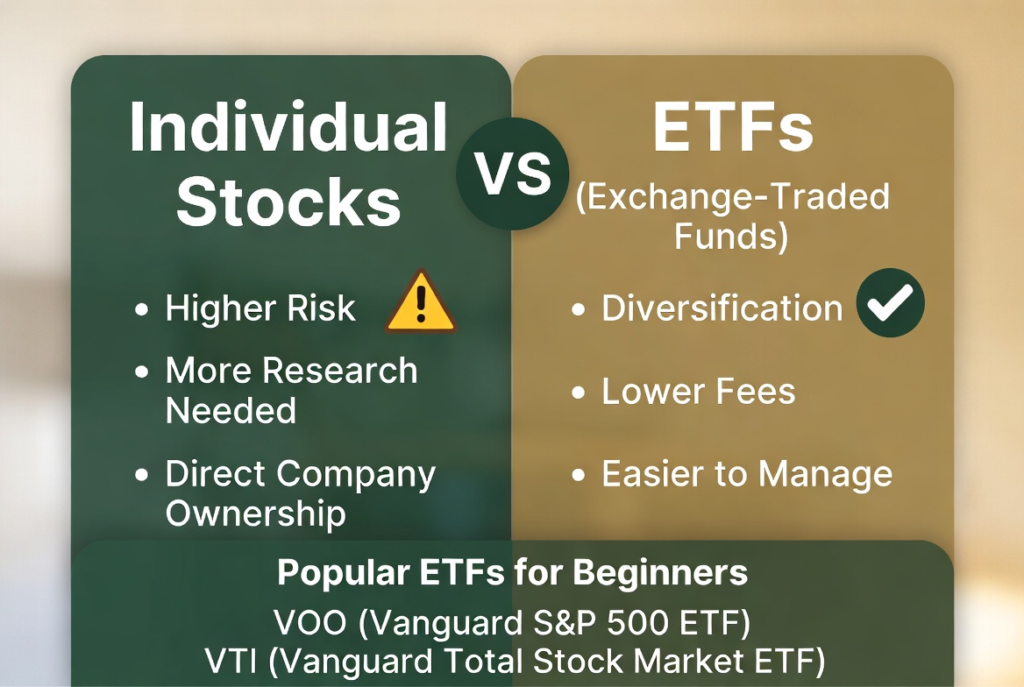
Step 3: Understand Stocks vs ETFs (Why Most Beginners Should Choose ETFs)
Individual Stocks: You buy shares of one company (Apple, Tesla, etc.). Higher risk and higher potential reward. Requires research.
ETFs (Exchange-Traded Funds): These are like baskets that hold dozens or hundreds of stocks in one fund. They give you instant diversification.
For beginners, ETFs are almost always smarter. They are cheaper, less risky, and historically perform very well over time.
Popular beginner ETFs in 2026:
- VOO or SPY → Tracks the S&P 500 (top 500 U.S. companies)
- VTI → Total U.S. stock market
- VXUS → International stocks
- VT → Entire world stock market (super simple one-fund option)
Step 4: Use Dollar-Cost Averaging (The Easiest Strategy)
Instead of trying to buy at the perfect time, do this:
- Invest a fixed amount every month (even $100 or $200).
- Buy automatically, whether the market is up or down.
This strategy removes emotion and has helped millions of regular people build serious wealth over time.
Step 5: Build Your Simple Portfolio
A super simple and effective beginner portfolio:
- 70–80% in a broad U.S. stock ETF (VOO or VTI)
- 20–30% in an international ETF (VXUS)
That’s it. Two funds. You can manage it in under 10 minutes per month.
As you get more comfortable, you can add a small bond ETF for stability later.
Real Example of Normal People
- Sarah (32, earns $62k/year) started investing $250/month in VOO in 2021. By early 2026 she has over $38,000 invested and is on track to hit $100k+ by age 40.
- Mike and Anna (couple, combined $95k) put $400/month into a simple ETF portfolio while paying off debt. They now have a growing investment account that gives them real peace of mind.
They didn’t become experts overnight. They just started and stayed consistent.
Your 7-Day Action Plan
Day 1–2: Open a brokerage account (Fidelity, Vanguard, or Schwab). Day 3: Transfer your first small amount ($100 minimum). Day 4: Research and buy your first ETF (start with VOO or VTI). Day 5: Set up automatic monthly investments. Day 6–7: Review your portfolio once and celebrate starting.
Important Tips for 2026
- Use tax-advantaged accounts when possible (Roth IRA or 401(k) if your job offers matching).
- Reinvest dividends automatically.
- Ignore daily market noise — check your account once a month.
- Never invest money you might need soon.
Final Encouragement
Investing in the stock market and ETFs is one of the most powerful things you can do for your future self.
You don’t need to be rich. You don’t need to be lucky. You just need to start and keep going.
The market has rewarded patient, consistent investors for decades — and it will continue to do so.
Have you ever invested in the stock market or ETFs before? What’s holding you back right now, or what’s one small step you’re ready to take this week?
Share in the comments — your story can inspire someone else who feels exactly like you do.
For more practical guides, check our articles on paying off debt fast, creating budgets that actually work, saving $10,000 in one year, and investing in crypto safely right here on Next Future Finance.
Your investing journey starts today. One ETF at a time.