

Nobody dreams of being in debt.
- Step 1: Stop the Shame — Start with Kindness
- Step 2: Get Crystal Clear on What You Actually Owe
- Step 3: Choose Your Strategy — Snowball or Avalanche?
- Step 4: Create Your “Debt Crusher” Payment
- Step 5: Make It Automatic and Painless
- Real People, Real Results
- Step 6: Protect Your Progress
- Your 30-Day Debt Freedom Starter Plan
- Final Truth
Yet here you are — maybe with credit cards, a car loan, student loans, or all of the above — feeling that heavy weight every time you check your bank account. The good news? You can pay off debt faster than you think without turning your life into a miserable punishment.
This is not another “cut everything and eat rice and beans” plan. This is a realistic, compassionate, and proven approach that real people with normal salaries are using right now to become debt-free while still enjoying their life.
Step 1: Stop the Shame — Start with Kindness
The first thing to do is stop beating yourself up.
Debt is not a moral failure. It’s often the result of life happening — medical bills, job loss, inflation, or simply not knowing better when you were younger. Forgive yourself. Shame makes you quit. Kindness keeps you going.
Once you release the guilt, you can focus on the solution instead of the problem.
Step 2: Get Crystal Clear on What You Actually Owe
Grab a piece of paper or open a simple spreadsheet and list every debt:
- Creditor name
- Current balance
- Minimum payment
- Interest rate
Sort them however feels best to you (we’ll talk about two popular methods in a moment). Seeing the full picture is scary at first, but it’s also incredibly empowering. Knowledge is power.
Step 3: Choose Your Strategy — Snowball or Avalanche?
There are two main ways to attack debt:
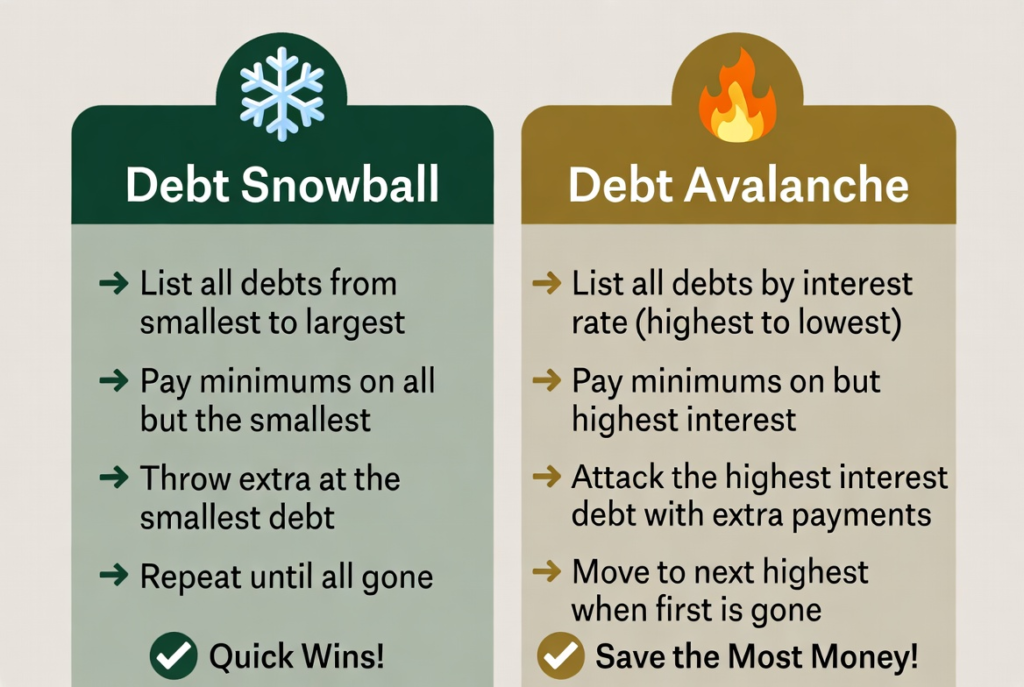
Debt Snowball (Best for motivation) Pay off the smallest debts first, regardless of interest rate. The quick wins give you momentum and dopamine hits that keep you going.
Debt Avalanche (Best for saving money) Pay off the highest interest rate debts first. This saves you the most in interest over time.
Most people do better with the Snowball because seeing progress feels better than being mathematically perfect. Choose what will keep you consistent.
Step 4: Create Your “Debt Crusher” Payment
Here’s the magic:
- Pay all minimum payments on every debt (so nothing goes late).
- Put every extra dollar you can find toward ONE debt (the one you chose in your strategy).
Where do those extra dollars come from? Small, painless changes:
- Cook at home 3 more nights a week
- Cancel one subscription you don’t use
- Sell stuff you already own
- Negotiate your bills (yes, you can call and ask for a lower rate)
Even $150–$300 extra per month can change everything.
Step 5: Make It Automatic and Painless
Set up automatic payments the day after you get paid. Out of sight, out of mind. You’ll adjust your lifestyle to what’s left and barely notice it after a couple of months.
Real People, Real Results
- Maria (teacher, $58k salary) paid off $21,000 in credit cards in 18 months using the Snowball method while still taking her kids to the movies once a month.
- James and Sarah (combined $82k) paid off $34,000 in student loans and a car loan in 26 months without giving up their annual beach trip.
They didn’t live like monks. They just got intentional.
Step 6: Protect Your Progress
Once a debt is paid off, take the money you were paying on it and roll it into the next debt. This creates a “snowball” effect that gets bigger and faster every month.
Also, build a small emergency fund of $1,000 while paying debt. Life will throw curveballs — having a little cushion prevents you from going back into debt.
Your 30-Day Debt Freedom Starter Plan
Week 1: List all debts and choose your method (Snowball or Avalanche) Week 2: Cut or reduce 2–3 small expenses and find your first “extra” $100–$200 Week 3: Set up automatic extra payment on your target debt Week 4: Celebrate your first progress (even if it’s only $50 paid off)
Every month after that, just keep going. The momentum will surprise you.
Final Truth
Paying off debt is not about deprivation. It’s about buying back your freedom, your peace, and your options.
You don’t have to be perfect. You just have to be consistent. One extra payment at a time, one small win at a time, you will get there.
You deserve to wake up without that heavy feeling in your chest. You deserve financial peace.
Have you ever paid off debt before? What’s the biggest debt you’re facing right now, or what’s one small step you’re ready to take this month?
Share in the comments — your story might give someone else the courage they need today.
For more practical money guides, check our articles on creating a budget that actually works, saving $10,000 in one year, building an emergency fund, and planning for retirement right here on Next Future Finance.
You’ve got this. The debt-free version of you is closer than you think.