



You don’t need to earn six figures to retire comfortably.
Most people believe retirement is only possible for high-income earners or those who make huge sacrifices. That’s simply not true. With a normal salary and the right plan, regular people are retiring with financial peace every single day.
Here’s a straightforward, realistic system that works even if you earn an average salary and started saving late.
Step 1: Change Your Mindset About Retirement
Retirement is not about stopping work completely. It’s about having enough money so you can choose how you spend your time.
The goal is not to become a millionaire overnight. The goal is to build a nest egg that covers your basic needs and gives you options.
Step 2: Calculate Your Real Retirement Number
Forget complicated formulas for now. Use this simple rule:
Multiply your current annual expenses by 25.
Example:
- If you spend $40,000 per year → you need about $1,000,000 saved.
- If you spend $50,000 per year → you need about $1,250,000 saved.
This is the classic “4% rule” — you can safely withdraw 4% of your savings each year without running out of money.
Start with your current expenses and adjust for inflation later.
Step 3: Use the Power of Consistent Saving
The secret is not how much you save each month — it’s how long you save consistently.
Realistic targets on a normal salary:
- Age 25–35 → Save 10–15% of your income
- Age 36–45 → Save 15–20%
- Age 46+ → Save 20% or more
Even saving $200–300 per month from age 30 can grow into hundreds of thousands thanks to compound interest.
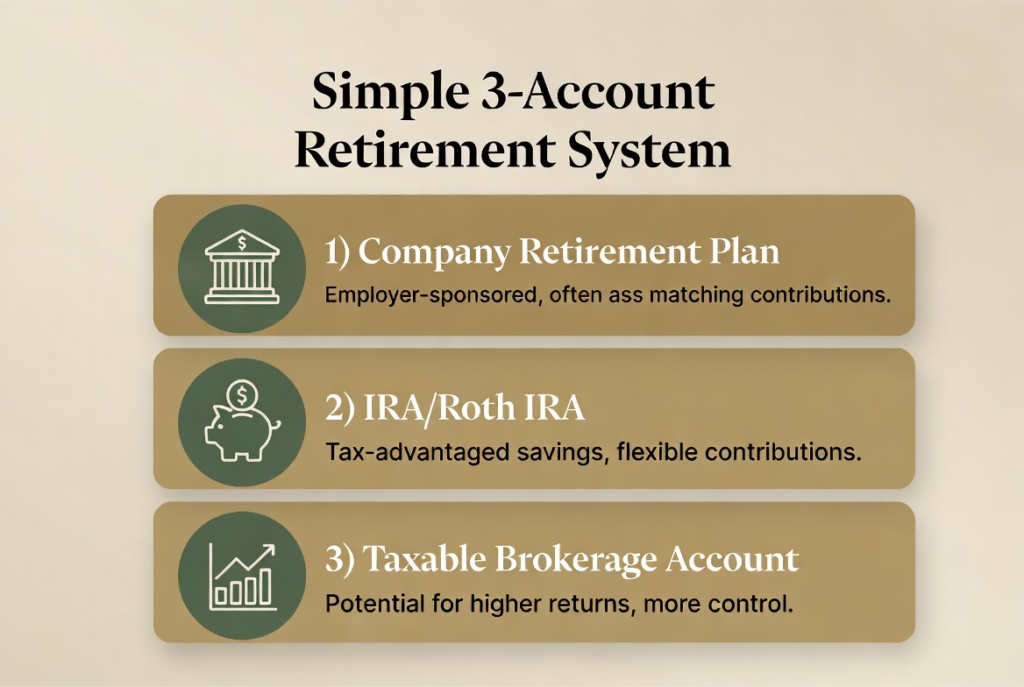
Step 4: The Simple 3-Account Retirement System
You only need three accounts:
- Company Retirement Plan (401k, 403b, etc.) Contribute enough to get the full employer match — this is free money.
- IRA or Roth IRA Great tax advantages and total control.
- Taxable Brokerage Account For extra savings once the first two are maxed.
Keep it simple: invest in low-cost index funds or target-date funds.
Step 5: Automate Everything
The people who succeed don’t rely on willpower.
- Set up automatic contributions the day you get paid
- Increase your contribution every time you get a raise
- Never touch the money until retirement
Automation turns good intentions into results.
Step 6: Protect Your Plan from Life
- Keep your emergency fund separate
- Review your plan once per year (not every month)
- Adjust when life changes (marriage, kids, job change)
Real Results on Normal Salaries
- Person earning $55,000/year who started saving 15% at age 32 → can retire with over $1.2 million by age 65.
- Person earning $70,000/year who started at age 40 → can still retire comfortably with $800,000+.
It’s never too late — but the earlier you start, the easier it becomes.
Your Action Plan This Week
- Calculate your personal retirement number (annual expenses × 25)
- Check if your job offers a retirement plan and sign up for at least the employer match
- Open an IRA if you don’t have one
- Set up your first automatic monthly contribution (even if it’s small)
You don’t need a perfect plan. You need a simple plan you actually follow.
Retirement is not a dream for the rich. It’s a choice for those who decide to start today.
Have you started saving for retirement? What’s your biggest challenge right now?
Share in the comments — your story can encourage someone else.
For more practical guides, check our articles on building an emergency fund, paying off debt, starting to invest with little money, and creating a bulletproof budget right here on Next Future Finance.
Your comfortable retirement starts with one small decision today.