



Imagine earning 8%, 10%, or even 12%+ annual returns on your money — without walking into a bank, without dealing with low savings account rates, and without locking your cash away for years in a CD.
This isn’t a dream. In 2026, thousands of everyday investors are doing exactly that through Peer-to-Peer (P2P) lending and other alternative investments.
At Next Future Finance, we’ve already shown you how AI can manage your money, how to invest in tokenized assets, how dividends work in the AI era, and how to create digital products for passive income. Today, we explore another powerful way to generate interest and passive income: moving beyond traditional banks.
Why Traditional Banks Pay You Almost Nothing
Right now, average savings accounts and CDs in many countries offer between 0.5% and 4% (depending on the country and rate environment). After inflation and taxes, your real return is often close to zero — or even negative.
Meanwhile, banks take your deposits and lend that money out at much higher rates (credit cards at 15–25%, personal loans at 8–15%, etc.). They keep the big difference as profit.
Modern investors are waking up and saying: “Why not cut out the middleman?”
That’s where Peer-to-Peer lending and alternative investments come in.
What Is Peer-to-Peer Lending?
P2P lending (also called marketplace lending) connects borrowers directly with individual lenders through online platforms. You lend money to real people or small businesses, and they pay you back with interest — usually monthly.
Popular platforms in 2026 include:
- LendingClub and Prosper (USA)
- Funding Circle
- Mintos and Bondora (Europe)
- Upstart (uses AI to evaluate borrowers)
- SoFi (more modern lending options)
Yields typically range from 6% to 12%+, depending on the risk level you choose.
Beyond P2P: Other Alternative Investments That Pay Interest
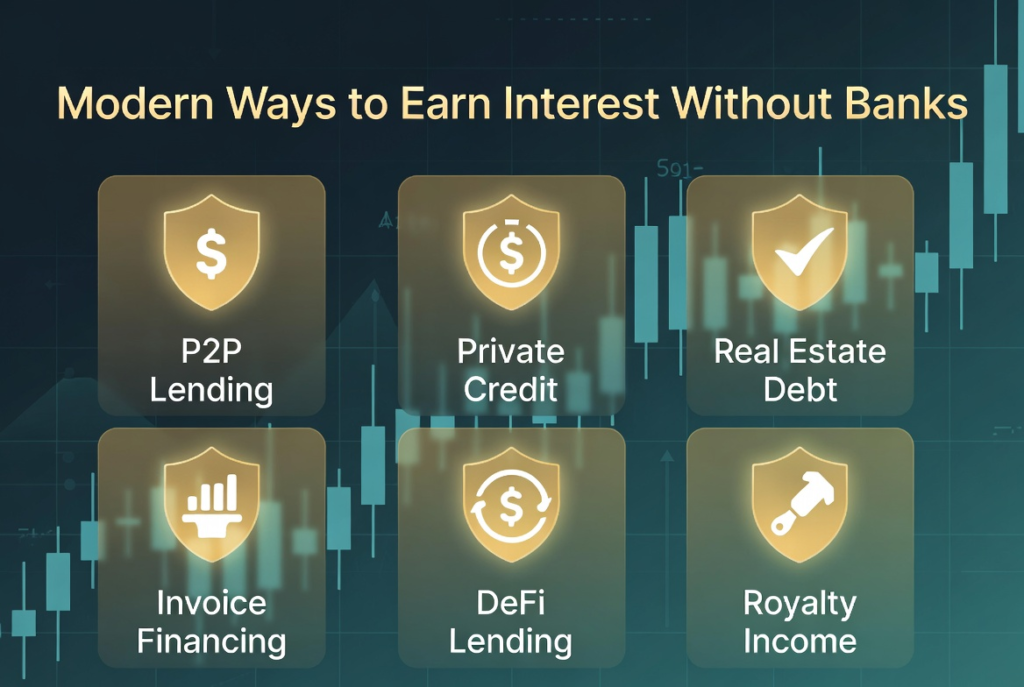
P2P is just one piece of the alternative investment world. Here are other modern options that can generate attractive yields without traditional banks:
- Private Credit / Direct Lending Lending to mid-sized companies through funds or platforms. Returns often range from 8% to 14%.
- Real Estate Debt (Mortgage Lending) Invest in real estate loans instead of owning property. Platforms like Groundfloor or Yieldstreet let you earn interest from property-backed loans.
- Invoice Financing / Factoring Buy invoices from businesses at a discount and get paid when the invoice is settled. Short-term, relatively stable returns.
- DeFi Lending Lend stablecoins on decentralized platforms (Aave, Compound, Morpho). Yields can be 5–15%, though they fluctuate more.
- Royalty Income Streams Invest in music royalties, patent royalties, or brand royalties through platforms like Royalty Exchange.
The Pros and Cons (Be Honest With Yourself)
Advantages:
- Higher yields than traditional savings
- Monthly or quarterly payments (great for cash flow)
- Diversification away from stocks and bonds
- Many platforms now use AI to reduce default risk
- You can start with as little as $25–$100
Risks:
- Default risk (borrowers may not pay back)
- Platform risk (what if the company goes out of business?)
- Lower liquidity (your money may be locked for 1–5 years)
- No government insurance like FDIC
Smart investors reduce risk by:
- Spreading money across many loans (auto-invest tools help)
- Choosing higher-quality borrowers
- Only investing money they can afford to tie up
- Mixing P2P with more stable alternatives
How to Get Started in 2026 (Step-by-Step)
- Educate yourself — Read platform reviews and understand how each works.
- Choose 2–3 platforms — Don’t put everything in one place.
- Start small — Begin with $500–$2,000 to test the waters.
- Use auto-invest features — Most platforms let you set criteria and automatically fund new loans.
- Reinvest returns — Let compounding work for you.
- Track performance — Review your portfolio every 3–6 months.
Many investors combine this strategy with the dividend stocks and digital assets we’ve covered in previous articles to create multiple reliable income streams.
Real Results People Are Seeing
In 2026, disciplined P2P and alternative investors are commonly reporting net annual returns between 7% and 11% after defaults and fees. Some aggressive portfolios in DeFi or private credit push higher, while conservative ones stay closer to 6–8%.
This income can supplement your salary, accelerate retirement savings, or help build generational wealth.
The Future of Earning Interest
As traditional banks continue to lose ground (as we discussed in “The Future of Banking”), alternative lending and private credit markets are expected to keep growing rapidly.
AI is making these platforms smarter at assessing risk, blockchain is increasing transparency, and more institutional money is entering the space — which brings more opportunities (and competition) for retail investors like you.
Final Thoughts: Take Control of Your Interest Income
You no longer have to accept the tiny returns traditional banks offer. Peer-to-Peer lending and alternative investments give you the power to earn real interest by putting your money directly to work.
This strategy fits perfectly into the “Future of Finance” philosophy: using technology and modern platforms to build passive income and greater financial freedom.
Would you consider putting part of your savings into P2P lending or alternative investments? Which option interests you most — P2P, real estate debt, or DeFi lending?
Share your thoughts in the comments below.
And if you enjoyed this article, check out our other pieces on passive income, dividend investing in the AI era, creating digital assets, and how technology is transforming money and banking right here on Next Future Finance.
Your money deserves to work harder for you.










Deja una respuesta