

It’s 2030. You need a loan. Instead of visiting a branch, filling out paperwork, and waiting days for approval, you open an app on your phone. Within minutes, an AI analyzes your financial history, DeFi protocols offer competitive rates from global lenders, and the money lands in your account instantly — all without a single human banker involved.
This scenario is no longer science fiction. Traditional banks, the institutions that have dominated finance for centuries, are facing an existential threat. Many experts believe large parts of traditional banking as we know it could disappear or shrink dramatically by 2030–2035.
At Next Future Finance, we’ve explored AI in personal finance, tokenization of real-world assets, and the battle between CBDCs and cryptocurrencies. Today, we look at the big picture: the future of banking itself — why traditional banks may fade, and what powerful new systems are rising to replace them.
Why Traditional Banks Are in Trouble
For over 200 years, banks have controlled three core functions:
- Holding your deposits
- Giving loans
- Facilitating payments
But technology is dismantling each of these one by one.
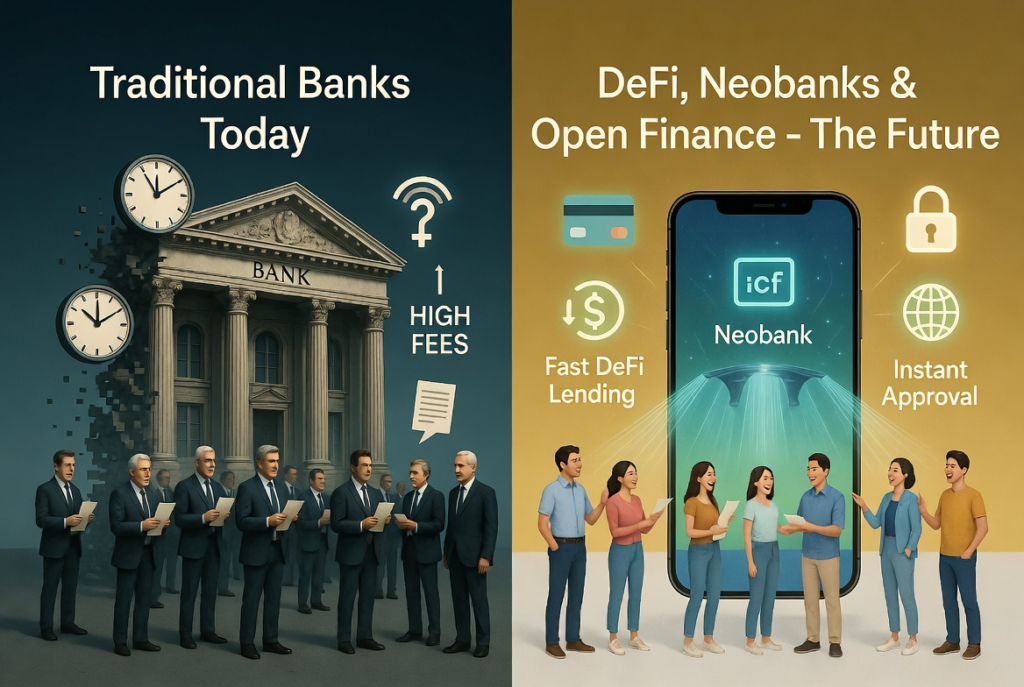
- High costs and inefficiency: Physical branches, thousands of employees, and slow legacy systems make traditional banks expensive to run.
- Slow service: Loan approvals that take days or weeks feel outdated when competitors deliver instant decisions.
- Poor customer experience: Many still force you to visit branches or deal with long call-center waits.
- Low interest on deposits: While you earn almost nothing on savings, banks lend your money at much higher rates.
Younger generations especially are moving away. Surveys in 2026 show that Gen Z and Millennials prefer digital-first solutions and are far less loyal to big traditional banks.
The result? Traditional banks are losing market share fast in deposits, lending, and payments.
What Will Replace Traditional Banks?
Three major forces are leading the revolution:
1. Neobanks (Digital-First Banks)
Neobanks like Revolut, Chime, Nubank, and Wise have already attracted hundreds of millions of users worldwide. They offer:
- No monthly fees
- Instant notifications and budgeting tools
- Higher interest on savings
- Seamless international transfers
They don’t have physical branches, which allows them to pass savings to customers. Many now offer investing, crypto, and even insurance — all inside one beautiful app.
2. DeFi (Decentralized Finance)
DeFi takes banking services and puts them on the blockchain, removing intermediaries entirely.
On platforms like Aave, Compound, and Uniswap you can:
- Lend money and earn real yields (often 5–15%+)
- Borrow instantly using crypto as collateral
- Trade assets 24/7 without a broker
- Earn interest on stablecoins
DeFi is still young and volatile, but it’s growing rapidly. In 2026, total value locked in DeFi protocols continues to hit new highs, showing strong demand for decentralized alternatives.
3. Open Finance (The New Open Banking)
Open Finance goes beyond Open Banking. It allows your financial data (with your permission) to be securely shared across different providers so the best services can compete for your business.
This means:
- Your salary data can automatically help you qualify for better loan rates
- AI tools from different companies can analyze all your accounts together
- You can switch providers instantly without losing history
Countries in Europe and parts of Asia are leading the way, with the US and others following closely.
How Banking Will Look in 2030
By the end of the decade, your “bank” might not be a bank at all. Instead, you’ll likely use a combination of:
- A neobank app for everyday spending and payments
- DeFi protocols for higher yields and borrowing
- AI-powered platforms that automatically move your money to the best opportunities
- Tokenized assets and CBDCs for stability and new investment options
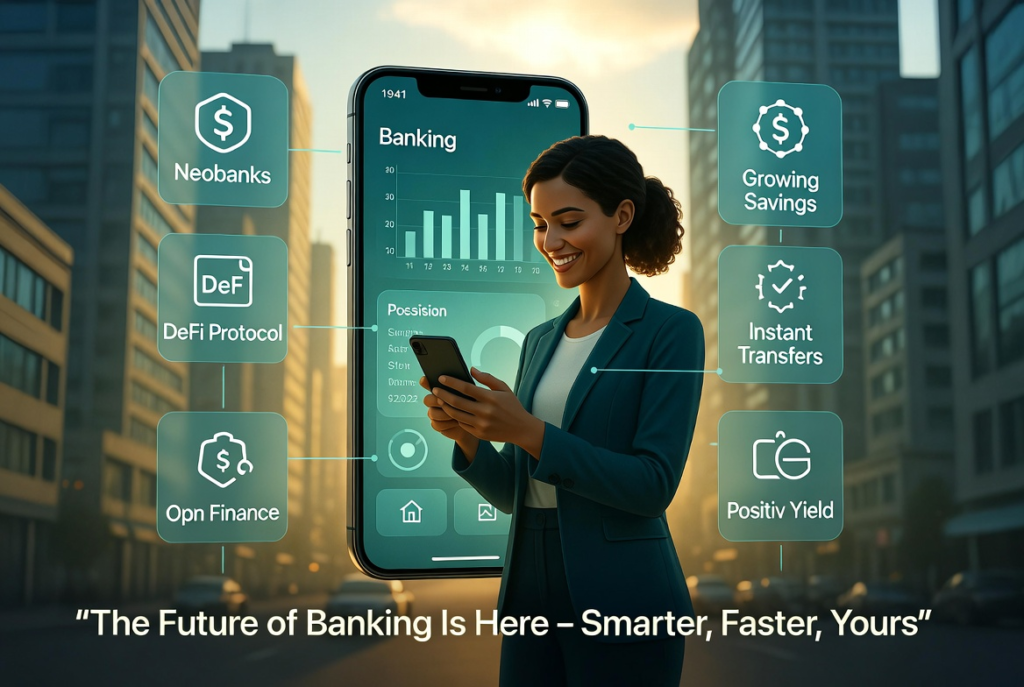
Payments will be instant and nearly free. Loans will be approved in minutes based on real-time data. Savings accounts could earn competitive returns without you lifting a finger.
The branch? Many will close or become experience centers rather than transaction points.
Benefits for You as a Customer
- Lower costs — Fewer fees, better rates
- Better experience — Beautiful apps, 24/7 access, instant service
- Higher returns — Earn more on your savings and investments
- Greater choice — Mix and match services from the best providers
- Global access — Send and receive money anywhere easily
This shift also supports the passive income and generational wealth strategies we’ve discussed before — because when your money works harder for you automatically, building wealth becomes much easier.
Risks and Challenges Ahead
Of course, change brings risks:
- Cybersecurity — More digital systems mean bigger targets for hackers
- Regulation — Governments are still figuring out how to oversee DeFi and open finance
- Volatility — DeFi can be risky during market crashes
- Digital divide — Not everyone is comfortable with fully digital finance
The winning strategy? Use neobanks for daily banking, explore DeFi gradually with small amounts, and keep some money in stable, regulated options (including future CBDCs).
How to Prepare for the Future of Banking Today
Here’s a practical 4-step plan you can start in 2026:
- Switch to a neobank — Try Revolut, Wise, or your local digital bank for everyday use.
- Start with DeFi safely — Use stablecoins on trusted platforms and learn the basics.
- Enable Open Banking — Connect your accounts where available to get better insights and offers.
- Use AI tools — Let smart agents (as we covered earlier) help you optimize across all your accounts.
The banks of the future won’t be buildings — they’ll be intelligent, interconnected systems working for you 24/7.
The Banking Revolution Is Already Here
Traditional banks won’t vanish overnight, but their dominance is ending. The combination of neobanks, DeFi, and open finance is creating a more efficient, customer-friendly, and innovative financial world.
This transformation perfectly complements everything we’ve discussed on Next Future Finance: AI managing your money, tokenized assets for investing, and understanding new forms of digital money.
The future belongs to those who adapt early.
What do you think — are you ready to move away from traditional banks, or will you stick with them for safety? Would you trust DeFi with part of your savings?
Share your thoughts in the comments below.
And if you want more insights into the future of finance, don’t miss our articles on AI in personal finance, tokenization, CBDCs vs crypto, and powerful strategies for passive income and generational wealth.
Your financial freedom in 2030 starts with the choices you make today.









Deja una respuesta