



You don’t need to be rich to start investing.
Many people believe they must wait until they have “enough money” before they can invest. The truth is: the best time to start investing is when you have little money — because time and consistency are far more powerful than a big starting amount.
Here’s a simple, realistic, and proven guide to begin investing even if you only have $50, $100, or $200 per month.
Step 1: Get Your Foundation Right First
Before you invest a single dollar, make sure these three things are in place:
- You have an emergency fund (even if it’s just $1,000)
- You are not carrying high-interest debt (credit cards above 15%)
- You have a basic budget that shows where your money is going
If those three are not ready, focus on them first. Investing while drowning in high-interest debt or with no safety net is risky.
Step 2: Start Extremely Small (The “$25 Rule”)
You can begin investing with as little as $25–$50 per month.
The goal is not the amount at the beginning — it’s building the habit.
When you start small:
- You learn without fear
- You get comfortable with the process
- You create the discipline that will serve you for decades
Step 3: Choose the Simplest and Most Effective Way to Invest
For beginners with little money, the best options are:
A. Index Funds or ETFs (Recommended for most people)
- Low fees
- Instant diversification
- Historically strong long-term returns
Popular and simple choices:
- S&P 500 Index Fund
- Total Stock Market Fund
- Target-Date Retirement Funds (automatically become more conservative as you age)
B. Retirement Accounts (Best tax advantage)
- If your job offers a 401(k) or similar plan → contribute at least enough to get the full company match (this is free money)
- Open an IRA or Roth IRA if you don’t have access to a workplace plan
C. Brokerage Account (Most flexible)
Use a low-cost broker that allows fractional shares so you can invest small amounts regularly.
Step 4: Use Automatic Investing (The Real Secret)
The people who succeed at investing are not smarter — they are more consistent.
Set up automatic monthly transfers:
- The day you get paid → money moves automatically to your investment account
- You never have to “remember” or feel the pain of manually transferring
This is called “paying yourself first” — and it works incredibly well.
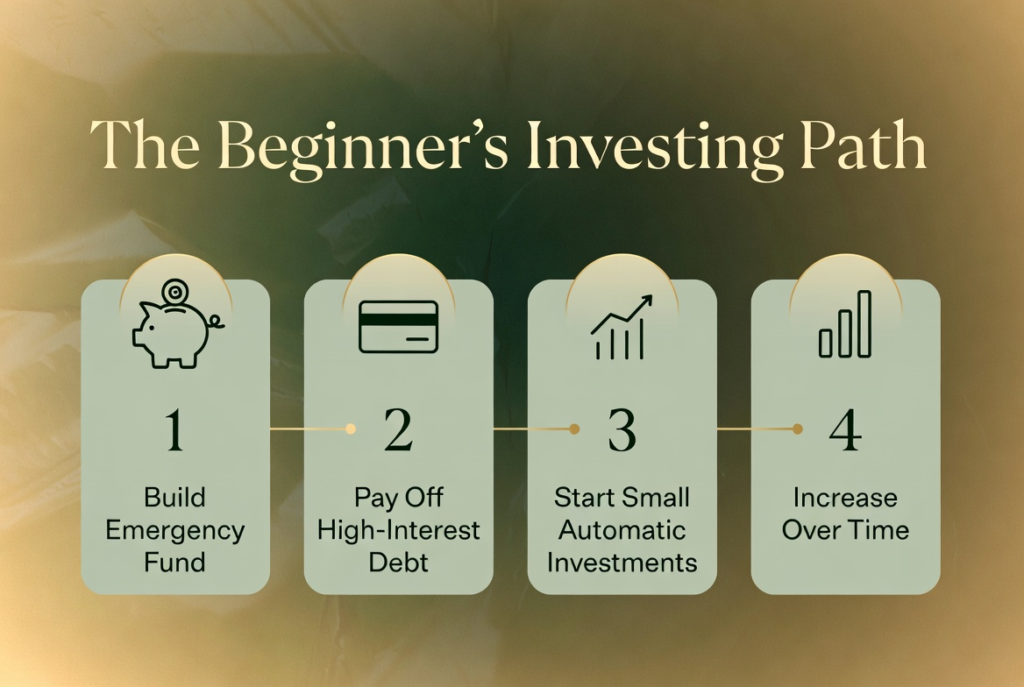
Step 5: Follow the “Increase Over Time” Rule
Once you get comfortable investing:
- Increase your contribution by 1% every 6–12 months
- Put any raise or bonus toward investing
- Aim to eventually save 15% or more of your income
This gradual increase is how normal salary earners become millionaires over time.
Real Example (Normal Salary)
Person earning $55,000 per year:
- Starts investing $100 per month at age 25
- Increases contribution by $25 every 2 years
- Average annual return of 8%
Result at age 65: Over $1,000,000
The same person starting at age 35 would need to invest almost 3 times more per month to reach the same result.
Time is your biggest advantage.
Common Beginner Mistakes to Avoid
- Trying to pick individual stocks
- Investing money you might need in the next 2–3 years
- Stopping contributions when the market goes down
- Chasing “hot tips” on social media
Keep it simple and boring. Boring wins in investing.
Your Action Plan This Week
- Open a brokerage or retirement account (many have $0 minimum)
- Set up your first automatic monthly investment (even if it’s only $50)
- Commit to increasing the amount every year
You don’t need to be perfect. You just need to start.
Investing is not about getting rich quickly. It’s about giving your future self options, freedom, and security.
Have you started investing yet? What’s holding you back, or what was your first step?
Share in the comments — your experience can help someone who is just starting.
For more practical finance guides, check our articles on building an emergency fund, paying off debt, creating a bulletproof budget, and saving for retirement right here on Next Future Finance.
Start small. Stay consistent. Your future self will thank you.











Deja una respuesta