

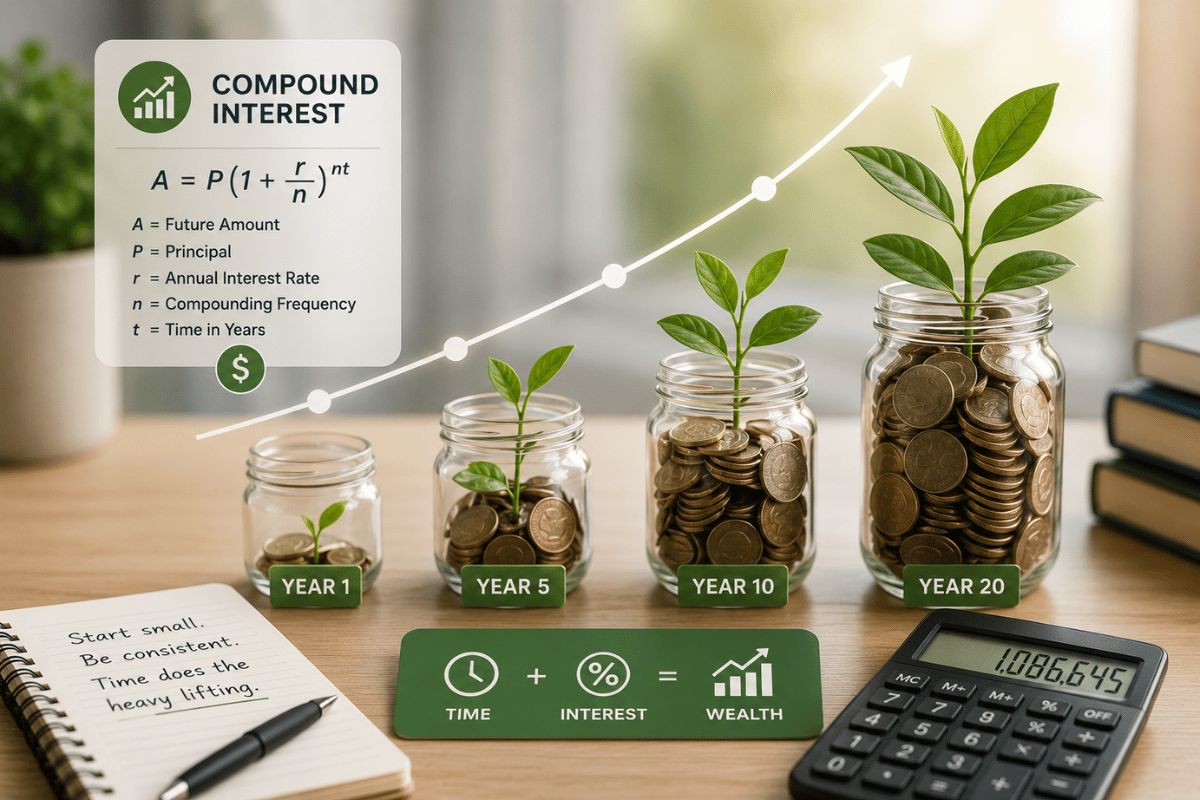

Albert Einstein reportedly called compound interest the eighth wonder of the world. Whether or not he actually said it, the sentiment is accurate. Compound interest is the mechanism by which small, consistent savings grow into substantial wealth over time without any additional effort.
- Simple Interest vs Compound Interest: The Core Difference
- How Compound Interest Is Calculated
- Compounding Frequency: Does It Matter?
- The Power of Time: Why Starting Early Changes Everything
- The Rule of 72: A Quick Mental Calculation
- Compound Interest Working Against You: The Debt Side
- How to Maximise Compound Interest in Your Favour
- Frequently Asked Questions
- Key Takeaways
Understanding it properly changes how you think about money. It makes starting early feel urgent, keeping high-interest debt feel dangerous, and leaving savings in a low-rate account feel like a genuine mistake.
This guide explains exactly what compound interest is, how the maths works, and how to use it to your advantage.
Simple Interest vs Compound Interest: The Core Difference
Simple interest is calculated only on the original amount you invested or borrowed (the principal). Compound interest is calculated on the principal plus any interest already earned. That distinction, while it sounds small, produces dramatically different results over time.
| Simple vs Compound: A Clear Example You invest $10,000 at 8% annual interest for 20 years. Simple interest: Interest earned each year: $800 (8% of $10,000 always) Total after 20 years: $10,000 + ($800 x 20) = $26,000 Compound interest (annual compounding): Year 1: $10,000 grows to $10,800 Year 2: $10,800 grows to $11,664 Year 10: grows to $21,589 Year 20: grows to $46,610 Compound interest produces $20,610 more from the exact same investment. |
How Compound Interest Is Calculated
The formula for compound interest is:
Future Value = Principal x (1 + Interest Rate / Compounding Periods) to the power of (Compounding Periods x Years)
In practice, you do not need to calculate this yourself. Every savings calculator and investment platform does it for you. But understanding the inputs helps you make better decisions:
- Principal: The starting amount you invest or save.
- Interest rate: The annual return on your investment.
- Compounding frequency: How often interest is calculated and added. Daily compounding produces slightly more growth than monthly or annual compounding.
- Time: The most powerful variable. Time has a greater effect on your final outcome than any other factor.
Compounding Frequency: Does It Matter?
Interest can compound daily, monthly, quarterly, or annually. More frequent compounding produces slightly better results because interest starts earning interest sooner.
| Compounding Frequency | $10,000 at 8% after 20 years |
| Annually | $46,610 |
| Quarterly | $47,911 |
| Monthly | $48,304 |
| Daily | $49,127 |
The differences are real but modest. Far more important than compounding frequency is the interest rate you earn and how long you leave the money invested.
The Power of Time: Why Starting Early Changes Everything
The single most impactful variable in compound interest is time. The longer money remains invested, the more powerful the compounding effect becomes. This is because the acceleration of growth increases over time: growth in year 30 is much larger in absolute terms than growth in year 5.
| Scenario | Result at Age 65 |
| Invest $5,000/year from age 25 to 35 (10 years), then stop | Approx. $615,000 at 8% |
| Invest $5,000/year from age 35 to 65 (30 years) | Approx. $567,000 at 8% |
| Start at 25 and invest every year until 65 (40 years) | Approx. $1,398,000 at 8% |
Read those numbers again. Investing for just 10 years starting at age 25 produces more wealth at 65 than investing for 30 years starting at age 35, even though the early investor contributed a third of the money. That is the power of compounding time.
The practical implication is clear: starting to invest at 25 instead of 35 is worth more than doubling your annual contribution later.
The Rule of 72: A Quick Mental Calculation
The Rule of 72 is a simple shortcut for estimating how long it takes money to double at a given interest rate. Divide 72 by the annual interest rate to get the approximate number of years.
| Annual Return | Years to Double (Rule of 72) |
| 3% (typical savings account) | 24 years |
| 6% (conservative portfolio) | 12 years |
| 8% (moderate portfolio) | 9 years |
| 10% (aggressive portfolio) | 7.2 years |
| 20% (high-interest debt) | 3.6 years |
The Rule of 72 also reveals the danger of debt. A credit card charging 20% APR doubles what you owe in just 3.6 years if you make only minimum payments.
Compound Interest Working Against You: The Debt Side
Compound interest is not always your friend. On debt, particularly high-interest debt like credit cards or payday loans, compounding works powerfully against you.
| How Debt Compounds: A Real Example Credit card balance: $5,000 Interest rate: 22% APR Minimum payment: $100/month Time to pay off: approximately 8 years and 2 months Total interest paid: approximately $4,800 Total paid: approximately $9,800 on a $5,000 debt Increasing payment to $200/month: Time to pay off: approximately 2 years and 4 months Total interest paid: approximately $1,100 Savings from higher payment: approximately $3,700 |
The minimum payment trap is one of the most financially damaging situations a person can be in. Compound interest on unpaid credit card balances can mean paying back nearly double the original amount. Paying down high-interest debt quickly is the equivalent of earning a guaranteed, risk-free return equal to the interest rate.
How to Maximise Compound Interest in Your Favour
Start as Early as Possible
The data is unambiguous. Every year you delay investing reduces your final outcome more than almost any other factor. Even investing a small amount now is better than waiting to invest a larger amount later.
Reinvest All Dividends and Returns
Compound interest works because returns are reinvested and generate their own returns. In an investment account, this means selecting dividend reinvestment (DRIP) options so that payouts automatically buy more shares rather than sitting as cash.
Minimise Fees
Investment fees compound in the same way returns do, but in reverse. A 1% annual fee on a $100,000 portfolio over 30 years at 7% growth costs approximately $200,000 in lost returns compared to a 0.1% fee. Keeping costs low is one of the highest-leverage actions you can take.
Maintain Consistency Over Time
Withdrawing from investments, pausing contributions during market downturns, or switching strategies disrupts the compounding process. Consistency and patience are the required inputs. The mathematics reward those who stay the course.
Eliminate High-Interest Debt First
Any debt with an interest rate above your expected investment return is a guaranteed negative compounding force. Paying off a 22% credit card is a better guaranteed return than almost any investment. Clear high-interest debt before prioritising investment, except for employer-matched retirement contributions which provide an instant 50% to 100% return.
Frequently Asked Questions
At what age is it too late to benefit from compound interest?
It is never too late to benefit, though the magnitude of the benefit decreases the less time you have. Someone at 50 investing for 15 years still benefits meaningfully from compounding. The question is not whether compounding helps, but how to optimise it given your current timeline. Starting at 50 and maximising contributions for 15 years still produces significantly better outcomes than starting at 55.
Does compound interest apply to a savings account?
Yes. A high-yield savings account compounds interest, typically daily or monthly. However, savings account rates are generally much lower than investment returns, so the compounding effect is more modest. The safety and liquidity of a savings account makes it appropriate for emergency funds and short-term savings, but not for long-term wealth building.
What is a realistic long-term return assumption for investing?
The US stock market has returned approximately 10% annually on average over the long term before inflation, and approximately 7% after inflation. Financial planners typically use 6% to 8% as a conservative projection for a diversified portfolio. Using a lower figure in your planning gives you a more conservative, defensible estimate.
How does inflation affect compound interest?
Inflation reduces the purchasing power of your returns. If your investment returns 8% but inflation is 3%, your real return is approximately 5%. This is why it matters to invest in assets that outpace inflation over time rather than keeping large amounts in low-interest cash savings.
Key Takeaways
| Summary: What Is Compound Interest? Compound interest earns returns on both your principal and your previously earned interest. Over time, this creates exponential rather than linear growth. Time is the most powerful variable. Starting early matters more than saving large amounts. The Rule of 72: divide 72 by your interest rate to estimate years to double your money. On debt, compounding works against you. Minimum payments on high-interest debt are extremely costly. Reinvest returns, minimise fees, and stay invested consistently to maximise the effect. |
Compound interest is not magic. It is mathematics applied patiently over time. The investors who build real wealth are not those who found the best stock tip or timed the market perfectly. They are the ones who started early, contributed consistently, kept costs low, and let compounding do its work undisturbed.
Disclaimer

The content on Next Future Finance is for informational and educational purposes only and does not constitute financial, investment, or legal advice. Always consult a qualified financial professional before making any financial decisions. Individual results may vary.