

I never wanted to become a professional investor. I just wanted to stop making stupid mistakes with my money.
For years I tried the traditional way. I read books like The Intelligent Investor, followed finance YouTubers, and attempted to analyze companies the old-fashioned way — reading 10-K reports, building spreadsheets, and second-guessing every decision. Most of the time I felt overwhelmed and underqualified. I made some wins, but I also made expensive mistakes that hurt.
Then, around late 2023, I started experimenting with AI in a more serious way. Not as a magic money machine, but as a tireless research partner that never sleeps and has read more financial data than any human possibly could.
What happened next surprised me. My investment decisions became noticeably better — not because I became a genius, but because I finally had a powerful thinking partner that helped me ask better questions and see things I would have missed.
This article is not about getting rich quick. It’s about how a regular person like me — with no Wall Street background, no finance degree, and limited time — uses AI to make smarter, calmer, and more confident investment decisions.
My First Real “Aha” Moment with AI
It was early 2024. I was considering investing in a promising tech company. On paper it looked great — strong growth, innovative product, good reviews. But something felt off. Instead of spending days doing manual research, I pasted the company’s latest earnings report into an AI tool and asked:
“Summarize the key risks that aren’t immediately obvious. Compare this company’s financial health to its three closest competitors. What questions should I be asking that most retail investors miss?”
The response was eye-opening. The AI pointed out rising customer acquisition costs, increasing dependency on a single supplier, and several accounting red flags I had completely missed. It also showed me that two competitors were actually in stronger positions.
I decided not to invest. Six months later the stock dropped over 40% after disappointing earnings. That single conversation probably saved me thousands of dollars.
That was the moment I realized AI wasn’t replacing my judgment — it was dramatically upgrading it.

How I Actually Use AI in My Investing Process
I’ve developed a simple, repeatable system that works for me. I don’t use AI to make final decisions — I use it to become a better-informed investor.
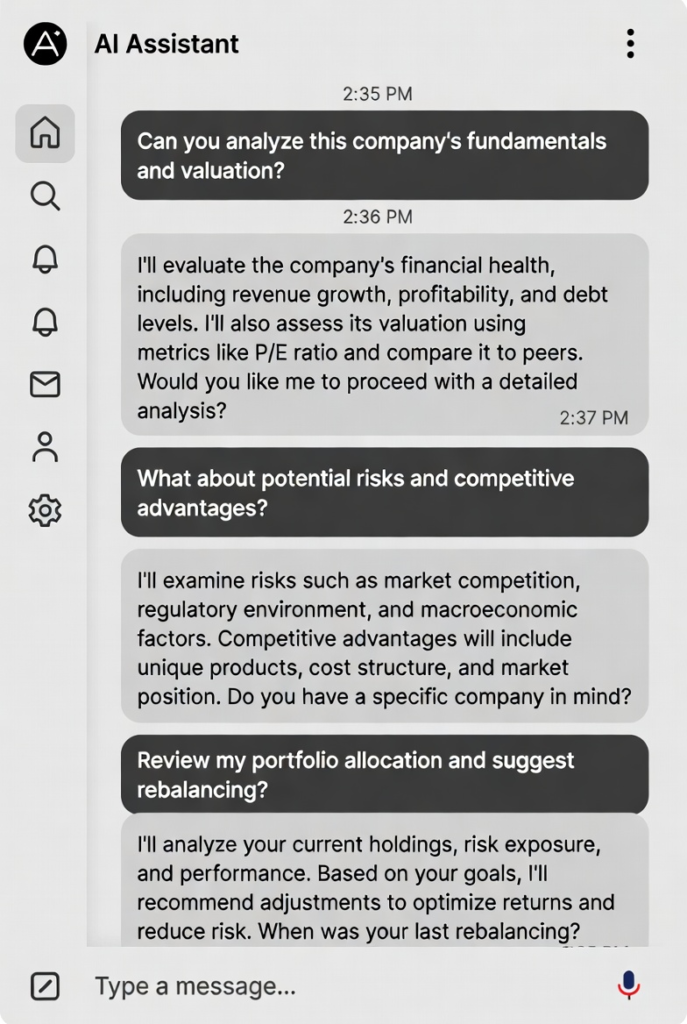
Research Phase Instead of spending hours reading scattered articles, I upload earnings reports, transcripts, or company presentations and ask targeted questions. I ask things like:
- “What are the biggest risks to this business over the next 3–5 years?”
- “How does this company’s margin trend compare to industry averages?”
- “Are there any accounting practices here that should raise concerns?”
Portfolio Analysis Every quarter I feed my entire portfolio into AI and ask it to review my asset allocation, concentration risk, and correlation between holdings. It often catches things like “Your exposure to semiconductor stocks has quietly increased to 28% — is that intentional?”
Scenario Planning This is where AI really shines. I ask questions like:
- “What would happen to my portfolio if interest rates rise another 1%?”
- “How would a recession similar to 2008 affect these holdings?”
- “Run a Monte Carlo simulation on my retirement projections with current savings rate.”
The answers are never perfect, but they give me ranges and probabilities that help me sleep better at night.
Learning and Pattern Recognition I regularly ask AI to review my past investment decisions and help me identify recurring mistakes. It’s like having a personal behavioral coach who only looks at my financial life.
The Limitations I’ve Learned (The Hard Way)
AI is incredibly powerful, but it’s not infallible. I’ve made mistakes by trusting it too much.
Early on, I asked AI for stock recommendations and got overly optimistic projections. I had to learn the hard way that I must always provide context, verify important facts, and never treat AI output as financial advice.
AI can hallucinate. It can be overly confident. And it doesn’t have skin in the game — it doesn’t feel the pain of losing money.
That’s why my rule is simple: AI is my research assistant and sounding board. I am still the one who makes the final decision.
What This Means for Regular People
The most exciting part of all this is that high-quality investment research is no longer reserved for professionals with Bloomberg terminals and teams of analysts.
Today, anyone with an internet connection can have access to analysis that would have cost thousands of dollars just a few years ago.
You don’t need to be a Wall Street expert. You don’t need to spend 40 hours a week researching. You just need to learn how to ask good questions and maintain healthy skepticism.
I’ve seen friends — teachers, engineers, small business owners — make significantly better decisions once they started using AI thoughtfully. They’re not beating the market consistently (almost nobody does), but they’re making fewer dumb mistakes, managing risk better, and feeling much more in control of their financial future.

My Honest Advice If You Want to Start
If you’re thinking about using AI for investing, here’s what I recommend:
- Start small. Pick one company or one decision you’re considering and test the process.
- Always provide context — the more specific you are about your situation, the better the answers.
- Cross-check important information with primary sources.
- Keep a journal of your decisions and AI conversations. You’ll improve faster.
- Remember that AI is a tool, not a crystal ball.
The goal isn’t to become the next Warren Buffett. The goal is to become a more thoughtful, informed, and less emotional investor.
Final Thoughts
Using AI hasn’t made me a genius investor. What it has done is remove a lot of the noise, fear, and inefficiency that used to cloud my judgment.
I still make mistakes. Markets are still unpredictable. But I now make decisions with much more clarity, better information, and a calmer mind.
If you’re a regular person who wants to take better care of your investments without quitting your job or getting a finance degree, AI might be one of the best tools you’ll ever have.
It won’t do the hard work for you — but it will make the hard work much more effective.
And in the long run, that might be the real edge.
Written by Dhanur