

I’ll be honest about something: for years I kept my emergency fund at the same bank I’ve had since college, mostly out of inertia. Same login, same debit card, same branch I never actually visit anymore. Then I finally sat down and compared what that account was paying against what a handful of online banks were advertising, and the number was embarrassing enough that I moved the money the same afternoon.
- Sample High-Yield Savings Rate Comparison (Illustrative, July 2026)
- Why the Rate Gap Is So Wide
- What to Check Beyond the Headline APY
- Confirming FDIC or NCUA Insurance
- Access and Withdrawal Considerations
- Why Rate Shopping Periodically Still Makes Sense
- Weighing Convenience Against the Rate Difference
- How Interest Compounds and Why the Compounding Schedule Matters
- Worked Example: What Switching Actually Looks Like
- Common Mistakes People Make When Chasing a Higher Rate
- Where a High-Yield Savings Account Fits Into a Bigger Plan
- Bottom Line
- Frequently Asked Questions
- Is a 5.00% savings account rate too good to be true?
- Are online savings accounts as safe as accounts at a traditional bank?
- How often do high-yield savings rates change?
- Is there a downside to switching savings accounts to chase a higher rate?
- Should I put my whole emergency fund into the highest-rate account I can find?
- Sources
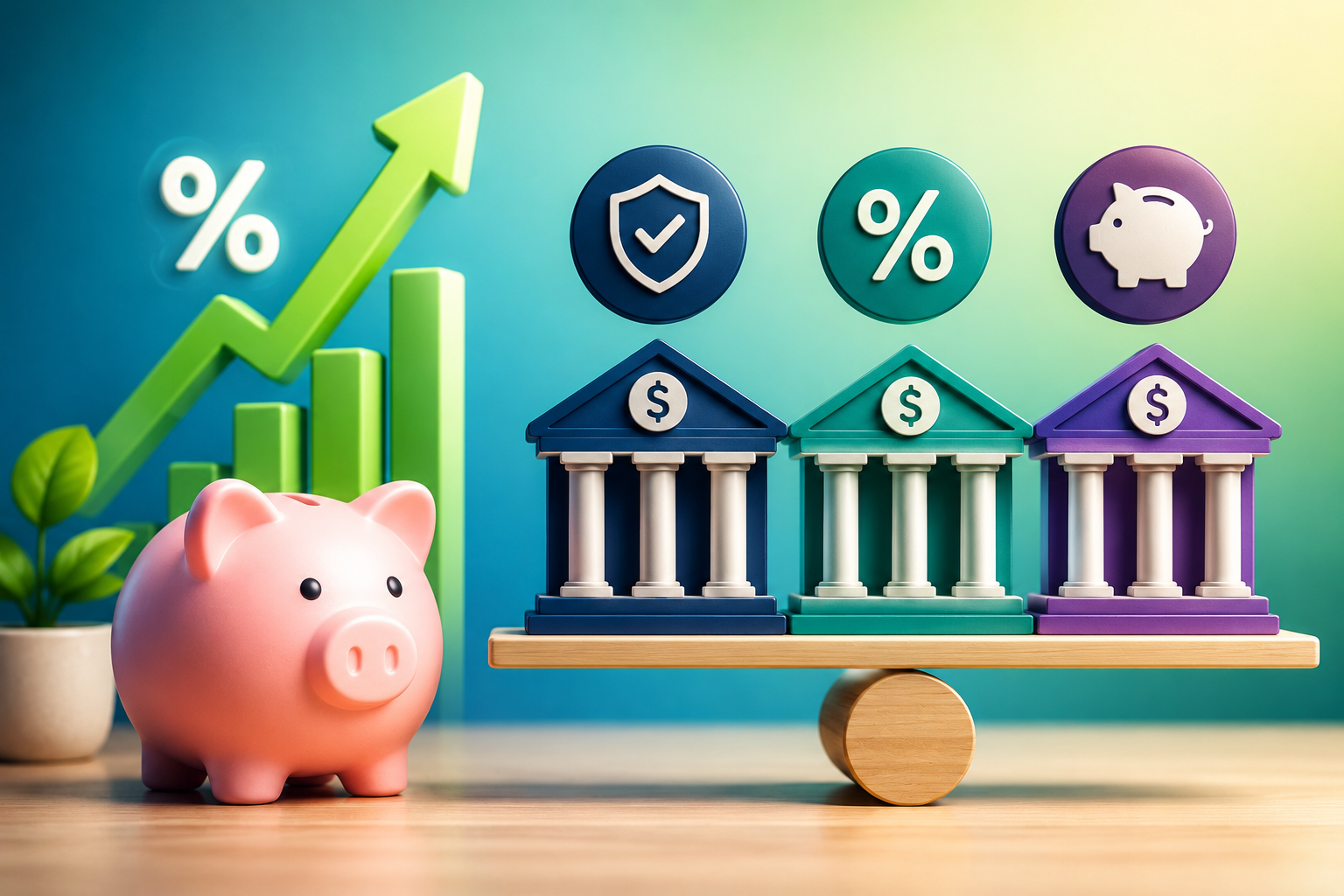
Here’s the gap, in case you haven’t looked either: the FDIC’s tracked national average savings rate sits at just 0.38 percent, while a number of online banks and fintech providers are currently advertising rates as high as 5.00 percent on standard savings accounts. On a $10,000 balance, that’s the difference between earning roughly $38 a year and earning close to $500, for functionally the same FDIC-insured product sitting in two different apps. Nobody is getting rich off that difference, but it’s also not nothing, and it’s the kind of gap that persists year after year purely because most people never bother to check.
💳 If you’re also carrying a balance you’re trying to pay down while you build savings, it’s worth reading about how credit card debt just hit another record in 2026 — the math on high-interest debt usually needs to come before the math on savings rates.
Sample High-Yield Savings Rate Comparison (Illustrative, July 2026)
| Provider Type | Approximate APY Range | Notable Consideration |
|---|---|---|
| National average (FDIC benchmark) | 0.38% | Baseline most brick-and-mortar banks are close to or below |
| Established online banks | 4.00% to 4.50% | Generally strong track record, FDIC insured |
| Newer high-rate fintech apps | Up to 5.00% | Rate may be promotional or apply only to a limited balance |
| Credit union savings accounts | Varies widely, sometimes competitive | Membership eligibility requirements may apply |
Why the Rate Gap Is So Wide
Traditional brick-and-mortar banks carry significant overhead in the form of physical branches, in-person staff, and legacy infrastructure, costs that get passed along in the form of lower rates paid to depositors. These banks are less reliant on deposit interest to attract customers who value in-person service and a broad ATM network, so there’s simply less competitive pressure pushing them to pay more.
Online-only banks and newer fintech savings apps carry a fraction of that overhead and often use competitive interest rates specifically as their primary tool for attracting deposits, since they lack the physical presence and brand recognition of an established national bank. Rate is often the only real lever these providers have to pull, so they pull it hard. This structural difference is why the rate gap has persisted for years and, if anything, has widened further as more fintech entrants compete aggressively for deposits.
It’s worth saying plainly: this isn’t a scam, a gimmick, or a “too good to be true” situation, in most cases. It’s a genuinely different business model, and the depositor is the one who benefits from the competition between them, as long as you do the (small) work of checking the fine print rather than just chasing the biggest number on a homepage banner.
What to Check Beyond the Headline APY
The advertised rate is only the starting point for evaluating a high-yield savings account, and a handful of details commonly determine whether the actual return matches expectations.
Confirm whether the advertised rate is a standard ongoing rate or a promotional rate that will drop after an introductory period. Some providers advertise an eye-catching rate for the first few months before reverting to a considerably lower figure once the promotional window closes, and it’s easy to miss that detail if you’re scanning quickly rather than reading the actual terms page.
Check whether the top rate applies to your entire balance or only up to a capped amount. Some accounts advertise a high headline rate that only applies to the first few thousand dollars, with any balance above that threshold earning a much lower rate, sometimes barely better than the account you were already trying to leave.
Confirming FDIC or NCUA Insurance
Before opening any high-yield savings account, verify that the institution is FDIC insured for a bank or NCUA insured for a credit union, which protects deposits up to $250,000 per depositor, per institution, in the event the institution fails. Most established online banks and fintech partnerships with banks carry this protection, but it is worth confirming directly rather than assuming, particularly for newer fintech apps that may operate through a partner bank relationship rather than holding a banking charter themselves. The provider’s website should clearly disclose which bank actually holds the deposits and provides the FDIC coverage, usually somewhere in the footer or a dedicated “how your money is protected” page.
If a provider makes that information hard to find, treat that as a signal on its own. A legitimate high-yield account has nothing to hide about who’s actually holding your deposit, and this same instinct, checking who’s really on the other end before you send money anywhere, is exactly the muscle worth building given how much imposter scams cost consumers in 2026.
Access and Withdrawal Considerations
High-yield savings accounts are generally not designed for frequent transactions, and some providers impose limits on the number of withdrawals or transfers permitted per month before charging a fee or reducing the rate. For a genuine emergency fund, where the goal is quick access when actually needed rather than frequent transfers, this limitation rarely matters in practice.
It is worth understanding this before choosing an account you might want to use more actively, though. Checking how quickly funds can be transferred back to a linked checking account is also relevant, since some online banks take a business day or two to complete a transfer. If you’re the kind of person who likes knowing money is reachable the same afternoon, this detail matters more to you than the extra half a percentage point of rate ever will.
Why Rate Shopping Periodically Still Makes Sense
Because interest rates on savings accounts move over time as broader economic conditions change, and because providers periodically adjust their competitive positioning to attract new deposits, a rate that was the best available option a year ago may no longer be competitive today. Households with a meaningful emergency fund balance sitting in an account paying a modest rate should periodically compare current offers.
Moving a balance to a more competitive account generally involves little more than opening a new account and initiating a transfer, with no penalty typically involved for savings accounts as there might be with a certificate of deposit. Once you’re in the habit of reviewing your accounts, it’s a natural moment to also glance at how your longer-term money is positioned, since the same “check it, don’t just set it and forget it” mindset applies to bigger decisions too, like whether your retirement calculator is using the wrong return assumption somewhere further down the timeline.
Weighing Convenience Against the Rate Difference
For very small balances, the dollar difference between a 0.38 percent and a 5.00 percent rate may not be large enough to justify opening an entirely new account and managing an additional login, especially for someone who values the simplicity of keeping everything at a single bank. Nobody needs to feel bad about deciding the hassle isn’t worth $12 a year.
For balances in the thousands of dollars or more, however, the annual dollar difference becomes significant enough that most people find the modest inconvenience of opening a second account worthwhile, particularly since many online savings accounts can be opened and linked to an existing checking account within a matter of minutes. That was ultimately what tipped it for me: the account opened faster than I expected, and the first transfer landed the next business day.
How Interest Compounds and Why the Compounding Schedule Matters
Beyond the headline annual percentage yield, it is worth understanding how often a given account actually compounds interest, since more frequent compounding, daily rather than monthly for instance, produces a slightly higher effective return even at the same stated APY. Interest earned in one period begins earning its own interest sooner, so the compounding schedule is quietly doing some of the work behind the number on the homepage.
Most competitive online savings accounts compound daily and credit interest monthly to the account balance, which is generally the most favorable structure available for a standard savings account. This detail rarely changes the overall provider decision on its own, but it is one more piece of the actual fine print worth confirming rather than assuming every account handles compounding identically.
Worked Example: What Switching Actually Looks Like
Numbers are more convincing than percentages floating on their own, so here’s a simple version using a $15,000 emergency fund, a fairly typical balance for a household with a few months of expenses saved.
- At the national average of 0.38%: roughly $57 in interest over a year.
- At a mid-range online bank rate of 4.25%: roughly $638 in interest over a year.
- At a promotional top rate of 5.00%: roughly $750 in interest over a year, assuming the full balance qualifies and the rate holds for the full year.
That’s a swing of nearly $700 a year, for money that was already sitting there doing nothing, in an account you’d have to actively choose not to open once you know the numbers. It won’t replace a paycheck, but it’s a genuinely free upgrade to a decision most people never revisit after the day they first opened a savings account, sometimes as a teenager, at whatever bank their parents already used.
Common Mistakes People Make When Chasing a Higher Rate
- Opening an account purely for the headline rate without checking whether it’s promotional or permanent.
- Not confirming FDIC or NCUA coverage before moving a meaningful balance.
- Ignoring balance caps, then being surprised when the “5% account” only pays that rate on the first $3,000.
- Treating a high-yield savings account like an investment account, when it’s still just a savings account meant for money you need to protect and access, not grow aggressively.
- Forgetting to actually move the money after opening the new account, which happens more often than you’d think — the new account sits empty while the old one keeps paying almost nothing.
Where a High-Yield Savings Account Fits Into a Bigger Plan
A high-yield savings account is the right tool for money you need to protect and access quickly: an emergency fund, a house down payment you’ll use within a year or two, or cash set aside for a known upcoming expense. It is not a substitute for investing money you won’t need for a decade or more, where the difference between an index fund and an ETF matters far more than a percentage point or two on a savings rate.
It’s also worth remembering that a rate difference of a few percentage points on a savings account, while meaningful, is small compared to what a fee difference can do to a long-term investment account. If you haven’t looked at it yet, what a 1 percent fee difference really costs you over 20 years is a useful companion read, since the same instinct that gets you to compare savings rates should also get you checking what you’re actually paying in fees on your retirement accounts.
And if student loan payments or a rent burden that’s already eating past 30 percent of your income are part of why building up savings feels slow right now, you’re not imagining it. It’s worth reading how student loan defaults are rising again in 2026 and, separately, how to actually use the 50/30/20 rule when rent alone is already over 30 percent of your income, since both of those pressures directly affect how much you have left to put into savings in the first place, regardless of which rate you’re earning on it.
Bottom Line
With online savings rates reaching as high as 5.00 percent against a national average of just 0.38 percent, where you keep your savings has become a meaningful financial decision rather than an afterthought. Comparing the actual terms, not just the headline rate, including whether it is promotional, whether it applies to your full balance, and whether the institution carries FDIC or NCUA insurance, ensures the account you choose delivers the return it appears to promise. It’s a fifteen-minute task that, on a decent-sized emergency fund, can be worth several hundred dollars a year, every year, for as long as the money sits there.
Frequently Asked Questions
Is a 5.00% savings account rate too good to be true?
Not necessarily, but it is worth checking whether the rate is promotional, capped at a certain balance, or standard and ongoing. High rates from legitimate, FDIC-insured providers do exist, but the details matter more than the headline number.
Are online savings accounts as safe as accounts at a traditional bank?
As long as the institution is FDIC insured, or NCUA insured for a credit union, deposits are protected up to $250,000 per depositor, per institution, regardless of whether the bank operates online-only or has physical branches.
How often do high-yield savings rates change?
Rates can change periodically based on broader interest rate conditions and each provider’s competitive strategy. It’s worth checking your account’s current rate every few months rather than assuming it stays fixed indefinitely.
Is there a downside to switching savings accounts to chase a higher rate?
The main downside is the minor inconvenience of managing an additional account and transfer times between institutions. For most savings accounts, there is no penalty for moving funds, unlike a certificate of deposit with an early withdrawal penalty.
Should I put my whole emergency fund into the highest-rate account I can find?
Generally yes, as long as it’s FDIC or NCUA insured and you understand any balance caps or promotional terms. Just make sure the account still gives you quick enough access if you ever actually need the money in an emergency, since access matters as much as rate for this specific bucket of savings.
This article is for general informational purposes only and is not financial advice. Interest rates change frequently; verify current rates and terms directly with each financial institution before opening an account.