



If you are carrying multiple debts and trying to pay them off, the order in which you tackle them makes a significant difference. Two methods dominate personal finance advice: the Debt Avalanche and the Debt Snowball. They use the same total monthly payment but produce different outcomes, financially and psychologically.
- The Debt Avalanche Method
- The Debt Snowball Method
- Real Numbers: Avalanche vs Snowball Compared
- The Financial Case for Debt Avalanche
- The Psychological Case for Debt Snowball
- What the Research Says
- A Third Option: The Hybrid Approach
- How to Start: A Step-by-Step Process
- Frequently Asked Questions
- Key Takeaways
This guide explains both methods clearly, shows you the real numbers, helps you understand which one will save you the most money, and helps you decide which one you will actually stick with.
The Debt Avalanche Method
The Debt Avalanche method prioritises paying off your highest interest rate debt first, regardless of the balance size.
Here is how it works:
- List all your debts from highest to lowest interest rate
- Make the minimum payment on every debt each month
- Put any extra money you have toward the debt with the highest interest rate
- When that debt is paid off, roll its payment amount into the next highest rate debt
- Continue until all debts are paid
The Avalanche method is mathematically optimal. By targeting the highest-interest debt first, you reduce the total amount of interest paid across all debts, and you become debt-free faster than any other approach.
The Debt Snowball Method
The Debt Snowball method prioritises paying off your smallest balance first, regardless of the interest rate.
Here is how it works:
- List all your debts from smallest to largest balance
- Make the minimum payment on every debt each month
- Put any extra money toward the smallest balance debt
- When that debt is paid off, roll its payment into the next smallest balance
- Continue until all debts are paid
The Snowball method was popularised by personal finance expert Dave Ramsey and is built on behavioural psychology rather than mathematics. By paying off smaller debts first, you get quicker wins, which builds momentum and motivation to continue.
Real Numbers: Avalanche vs Snowball Compared
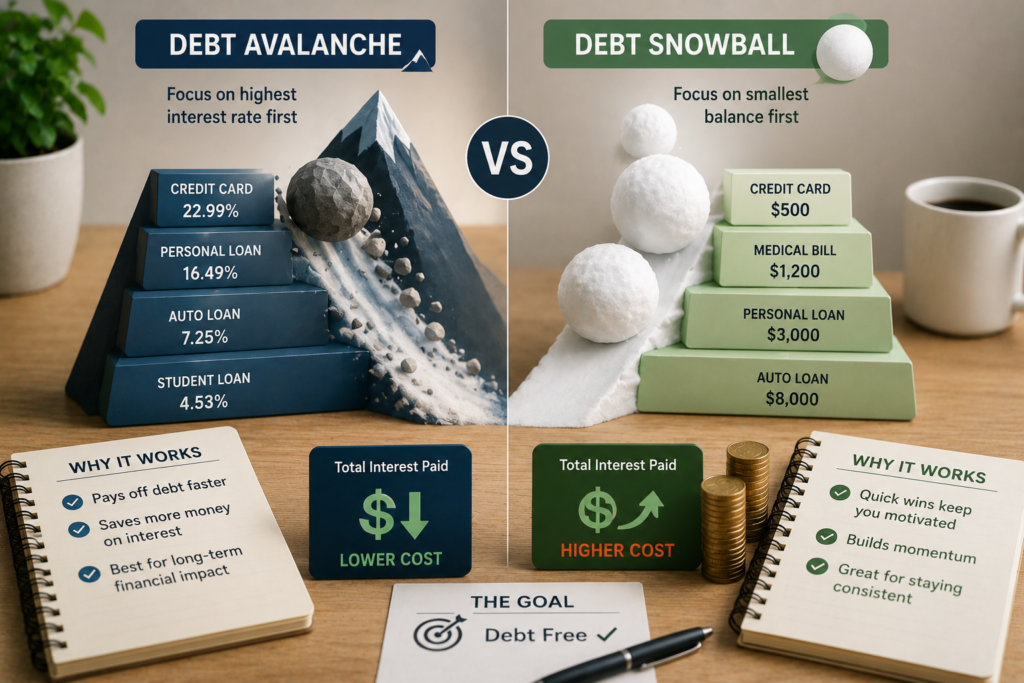
Let us use a realistic example to show the financial difference. Assume you have the following debts and $500 per month available for debt repayment (covering all minimums plus extra).
| Debt | Balance / Rate / Minimum |
| Credit Card A | $4,200 at 24.99% APR / $84 minimum |
| Personal Loan | $8,500 at 15.00% APR / $170 minimum |
| Credit Card B | $1,800 at 19.99% APR / $36 minimum |
| Car Loan | $11,200 at 6.99% APR / $224 minimum |
Total minimums: $514. Let us assume the person stretches to $600 per month total, giving $86 in extra payment capacity each month.
| Comparison | Debt Avalanche | Debt Snowball |
| Order of payoff | Card A (24.99%) first | Card B ($1,800) first |
| Total interest paid | Approximately $4,100 | Approximately $4,680 |
| Time to debt-free | Approximately 38 months | Approximately 40 months |
| First debt paid off | Month 22 (Card A) | Month 9 (Card B) |
| Number of early wins | Fewer, later | More, earlier |
| The Key Takeaway From These NumbersThe Debt Avalanche saves approximately $580 in this example.The Debt Snowball pays off the first debt approximately 13 months sooner. The financial difference is real but not enormous for most debt portfolios.The behavioural difference, however, is significant for many people. |
The Financial Case for Debt Avalanche
If your priority is minimising the total amount of money you spend paying off debt, the Avalanche method wins every time. This is not a matter of opinion. The mathematics are clear: paying off your most expensive debt first reduces the rate at which interest accumulates across your total debt portfolio.
The Avalanche method is especially powerful when:
- You have a high-interest debt with a large balance
- The interest rate difference between your debts is significant (for example, 24% vs 7%)
- You are disciplined, motivated by data, and do not need quick psychological wins to stay on track
- You want to reach debt freedom as quickly as possible in calendar time
The Psychological Case for Debt Snowball
The Snowball method exists because humans are not purely rational. Paying off debt is hard. It takes months or years of discipline. Many people start a debt payoff plan and abandon it before completion.
The Snowball method recognises that a plan you abandon is worth nothing, while a plan you stick with produces results even if it is slightly less mathematically efficient. Paying off a small debt completely triggers a genuine sense of accomplishment that reinforces the behaviour.
The Snowball method tends to work better for people who:
- Have struggled to maintain financial discipline in the past
- Feel overwhelmed by the number of debts rather than the total amount
- Need visible progress to stay motivated
- Have debts with similar interest rates where the mathematical difference is small
What the Research Says
Behavioural economics research supports the psychological effectiveness of the Snowball method. A study published in the Journal of Marketing Research found that people are more likely to continue paying down debt when they focus on eliminating individual accounts rather than reducing the total balance across all debts.
However, the same research acknowledged that the Avalanche method produces better financial outcomes for people who maintain their plan to completion. The key variable is completion. The best debt payoff method is the one you will actually finish.
A Third Option: The Hybrid Approach
Many financial advisors suggest a hybrid approach for people who want both psychological momentum and mathematical efficiency:
- Pay off one or two very small debts immediately to clear the mental clutter and get quick wins
- Then switch to the Avalanche method, targeting the highest-interest debts for the remainder of the payoff
This approach gives you the early motivation of the Snowball while capturing most of the savings from the Avalanche. For someone with a $500 credit card balance at 19% alongside much larger debts, clearing that $500 balance quickly and then switching to Avalanche makes practical sense.
How to Start: A Step-by-Step Process
Step 1: List Every Debt
Write down every debt you have with three pieces of information: the outstanding balance, the interest rate, and the minimum monthly payment. Include credit cards, personal loans, car loans, student loans, and any money owed to family if repayment is expected.
Step 2: Calculate Your Total Minimum Payments
Add up the minimum payments on all debts. This is the non-negotiable monthly baseline. If you cannot cover the minimums, you have a cash flow problem to address before choosing a payoff strategy.
Step 3: Find Your Extra Payment Capacity
Look at your monthly budget and identify how much you can contribute above the minimum total. Even $50 extra per month accelerates debt payoff significantly. Use the budget framework from your financial planning (or the 50/30/20 method) to free up money from the Wants category.
Step 4: Order Your Debts
For Avalanche: order from highest to lowest interest rate. For Snowball: order from smallest to largest balance.
Step 5: Direct Extra Payments
Every month, pay the minimum on all debts and direct every extra dollar toward the top debt on your list.
Step 6: Roll Payments Forward
When a debt is paid off, do not reduce your total monthly debt payment. Take the amount you were paying on that debt and add it to the payment for the next debt on the list. This is the rolling snowball or avalanche effect that accelerates progress dramatically.
| Month | What Changes |
| Month 1-9 | Paying minimums + extra on priority debt |
| Month 10 | First debt paid off: roll its payment into next debt |
| Month 15 | Second debt paid off: roll into third |
| Month 22 | Third debt paid off: roll into fourth |
| Month 38 | Final debt paid off: total freedom |
Frequently Asked Questions
Should I stop investing while paying off debt?
It depends on the interest rate. High-interest debt (above 8-10%) should generally be prioritised over investing, because the guaranteed return from eliminating that debt exceeds expected investment returns. Always contribute at least enough to capture any employer match in a retirement account: that is an instant 50-100% return. For low-interest debt (under 5-6%), investing and debt repayment simultaneously may be more beneficial.
What about student loans: Avalanche or Snowball?
Student loans are often worth treating separately from consumer debt because they may carry lower interest rates, offer income-based repayment options, and in some cases provide tax deductions on interest. Evaluate the interest rate of each loan and fit them into your overall Avalanche or Snowball order based on their rate and balance.
Does it matter which method I choose if I only have two debts?
With only two debts, the method matters less. The decision simplifies to: which debt charges more interest? Pay that one off first. The Avalanche method for two debts is simply paying the more expensive one first.
What if my minimum payments are already my entire budget?
This is a serious situation that a debt payoff strategy alone cannot solve. You need either to increase income or reduce expenses enough to create even a small surplus. A non-profit credit counselling service can help with this situation and may be able to negotiate lower interest rates or consolidate debts through a debt management plan.
Key Takeaways
| Summary: Debt Avalanche vs Debt Snowball Avalanche: pay highest interest rate debt first. Saves the most money overall. Snowball: pay smallest balance first. Provides faster psychological wins. The financial difference between the two methods is real but often modest. The best method is the one you will actually complete. Always roll paid-off debt payments into the next debt on your list. A hybrid approach (one quick win, then Avalanche) often provides the best of both. |
Your debt does not care which method you choose. What matters is that you choose one, commit to it, and see it through. Every month you stay consistent, the interest you are paying shrinks and your financial future improves. Start today.
Disclaimer

The content on Next Future Finance is for informational and educational purposes only and does not constitute financial, investment, or legal advice. Always consult a qualified financial professional before making any financial decisions. Individual results may vary.