

Imagine creating something once — a course, an e-book, or a digital collection — and then earning money from it for years, even while you sleep, travel, or spend time with family. No inventory. No shipping. No repeated work.
- Why Digital Assets Are Perfect for Passive Income
- 1. Online Courses: The King of Digital Passive Income
- 2. E-books: Simple, Fast, and Evergreen
- 3. NFTs and Digital Collectibles: The High-Upside Option
- Step-by-Step: How to Create and Launch Your First Digital Asset
- Real Income Potential in 2026
- Risks and Smart Tips
- Getting Started Today
- Build Once, Earn Forever
That’s the power of digital assets. In 2026, more people than ever are building serious passive income streams by creating and selling online courses, e-books, and NFTs.
At Next Future Finance, we’ve explored AI in personal finance, tokenization, the future of banking, and dividend investing in the AI era. Now we move into one of the most accessible and scalable ways to build wealth: creating your own digital products that can generate income indefinitely.
Why Digital Assets Are Perfect for Passive Income
Digital products have massive advantages over traditional businesses:
- Extremely low production cost after the initial creation
- Infinite scalability (you can sell to 100 or 100,000 people without extra work)
- Full ownership and control
- Global reach — anyone in the world can buy instantly
- High profit margins (often 80–95%)
Once created, these assets can keep earning for many years with minimal maintenance.
1. Online Courses: The King of Digital Passive Income
Online courses remain one of the most profitable digital assets in 2026.
How to create a successful course:
- Choose a topic you know well (finance, investing, AI tools, personal development, skills, etc.)
- Structure it with clear modules, video lessons, worksheets, and quizzes
- Use platforms like Teachable, Kajabi, Thinkific, or even YouTube + Gumroad
- Price between $47 and $997 depending on depth and value
Pro tip: Use AI tools (like the smart agents we discussed before) to help script lessons, create slides, generate quizzes, and even translate your course into multiple languages.
Many creators earn $5,000 – $50,000+ per month from a single well-made course after the initial launch.
2. E-books: Simple, Fast, and Evergreen
E-books are one of the easiest digital assets to start with.
Steps to create and sell e-books:
- Pick a specific problem your audience wants to solve (example: “How to Start Dividend Investing in the AI Era”)
- Write 30–100 pages using tools like Google Docs or Notion
- Design a professional cover with Canva or hire on Fiverr
- Publish on Amazon Kindle Direct Publishing (KDP), Gumroad, or your own website
- Price between $9.99 and $29.99
E-books can generate royalties for years. Many authors have “evergreen” books that sell consistently month after month.
3. NFTs and Digital Collectibles: The High-Upside Option
While the NFT hype has cooled since 2021–2022, utility-based NFTs are still a powerful way to create digital assets in 2026.
Ideas that work well:
- Exclusive financial education content (private community access)
- Fractional ownership of larger digital products
- Limited-edition art or financial reports with special benefits
- Membership passes for your future courses or updates
Platforms like OpenSea, Foundation, or newer utility-focused marketplaces make it easier than ever.
Important: Focus on real utility and value rather than pure speculation.
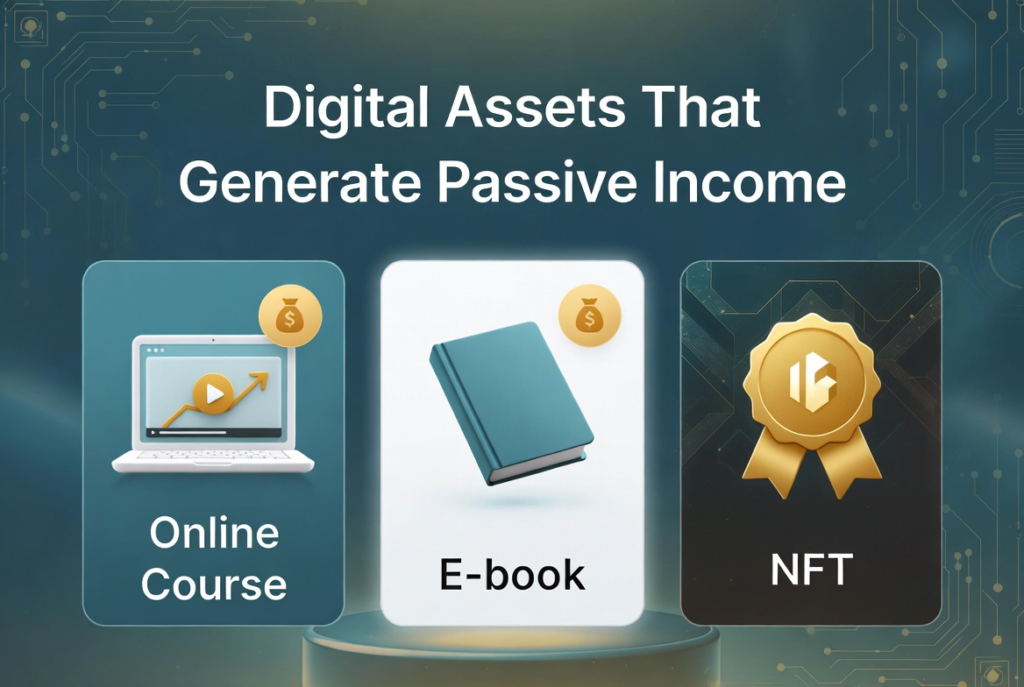
Step-by-Step: How to Create and Launch Your First Digital Asset
- Choose Your Niche Focus on what you know or are passionate about. Finance-related topics perform very well on Next Future Finance’s audience.
- Validate the Idea Ask your audience on social media, email list, or X (Twitter) what they would pay for.
- Create the Product
- Courses: Record with Loom or Descript + AI editing
- E-books: Write consistently or use AI assistance for research
- NFTs: Design with Midjourney or hire an artist
- Build a Simple Sales System Use Gumroad, Stan Store, or your own website with Stripe.
- Market It
- Email list (highly recommended)
- Content marketing (blog posts, YouTube, LinkedIn)
- Social media and collaborations
- Automate Everything Set up automatic delivery, payments, and follow-up emails so the income becomes truly passive.
Real Income Potential in 2026
- Beginner level: $500 – $3,000/month
- Intermediate: $5,000 – $15,000/month
- Advanced creators: $20,000 – $100,000+/month from multiple digital products
The best part? Once you have 3–5 successful digital assets, they start working together (a course can promote your e-book, which promotes your NFT membership, etc.).
Risks and Smart Tips
- Saturation — Choose a specific niche instead of something too general
- Quality matters — Low-quality products damage your reputation
- Platform dependency — Build your own email list and website as your main asset
- Updates — Plan to refresh content every 1–2 years
Combine this strategy with the dividend investing and tokenized assets we’ve covered before for multiple streams of truly passive income.
Getting Started Today
You don’t need to be perfect. Start with one simple product:
- A short e-book (30–40 pages)
- A mini-course (3–5 lessons)
- A small NFT collection with real utility
Use AI tools heavily — they can cut your creation time by 50–70%.
Build Once, Earn Forever
Creating digital assets is one of the most leveraged ways to build wealth in the digital age. You invest your time and knowledge once, and then technology does the heavy lifting.
This approach perfectly complements everything we talk about on Next Future Finance: using technology to create freedom, generate passive income, and build generational wealth.
What digital asset are you most excited to create first — an online course, an e-book, or something with NFTs? Have you already created any digital products?
Share your thoughts and questions in the comments below.
Explore our other articles on passive income strategies, AI-powered finance, dividend investing, and more right here on Next Future Finance.
Start creating today. Your future passive income is waiting.